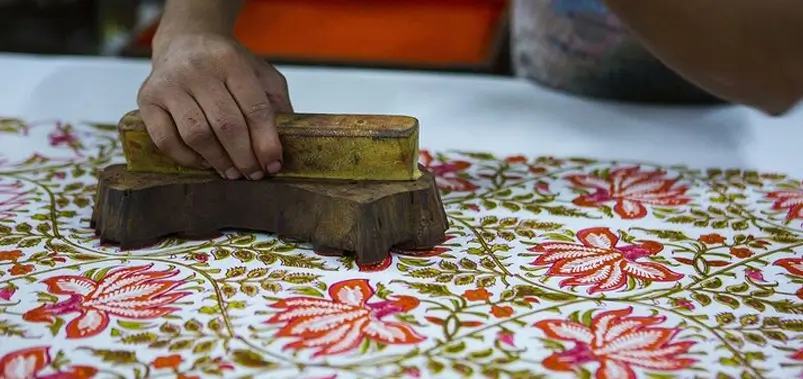
Among Jaipur's many crafts, hand block printing stands out for how visible and tangible the entire process is. Within a single workshop visit, you can watch a block carved decades ago being loaded with natural dye, pressed onto fabric with a practiced, rhythmic motion, and lifted to reveal a pattern that will be repeated, by hand, hundreds of times across a single length of cloth.
This craft belongs to the Chippa community, whose name in Hindi literally means "to print," a community that has practiced this work for centuries in towns just outside Jaipur, most notably Bagru. A visit to a Chippa community workshop offers something increasingly rare in craft tourism: an unfiltered look at a living tradition, still practiced by the families who have always practiced it, in the same villages where it has been done for generations.
This guide covers the history of block printing in the Jaipur region, the distinct styles you will encounter, what an actual workshop visit involves, and how to shop for genuine hand printed textiles afterward.
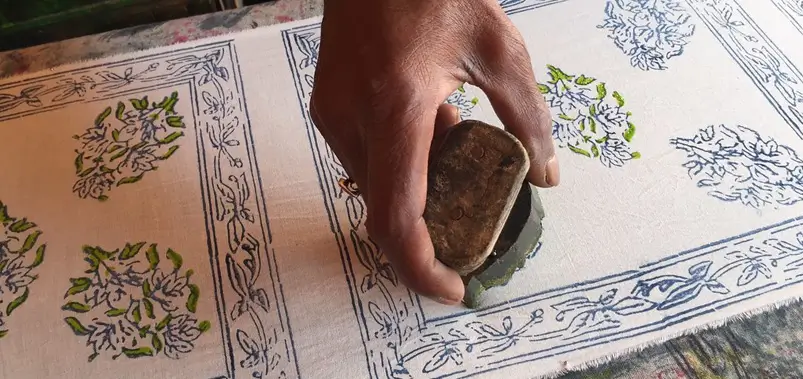
The story of hand block printing Jaipur is, fundamentally, the story of the Chippa community. Centuries ago, Chippa artisans settled in towns surrounding Jaipur, drawn by environmental conditions perfectly suited to their craft, soft river water ideal for washing and dyeing fabric, and clay rich soil used in certain stages of the printing process.
In Bagru, a town roughly thirty kilometres from Jaipur, the Chippa community has been practicing block printing for an estimated three to five hundred years, depending on the source. What began as printing for local use, particularly turbans and everyday cotton fabrics, expanded over time to include silk and chiffon, and during the Mughal era, Bagru's intricate designs found their way into royal courts and the wardrobes of nobility.
Like many traditional crafts, Bagru block printing faced near extinction during the twentieth century, as industrialisation and synthetic dyes offered cheaper, faster alternatives. That the craft survives today, practiced by over a hundred cottage scale workshops in Bagru alone, is largely due to artisan families who refused to abandon their slow, traditional methods, and to a more recent revival of global interest in handmade, sustainable textiles.
Discover Jaipur's Timeless Hand Block Printing Heritage
Experience the traditional art of Jaipur by visiting authentic hand block printing workshops, meeting skilled local artisans, and exploring the city's rich cultural heritage. Travel in a private chauffeur-driven car and enjoy a personalized journey through Jaipur's artistic and historic treasures.
A common point of confusion for first time visitors is the difference between Bagru block printing and Sanganeri block printing, both practiced by Chippa communities in towns near Jaipur, but visually and technically quite distinct.
Bagru printing is defined by its bold, earthy aesthetic, geometric patterns, intricate lattices, and nature inspired motifs like marigold (gainda), rose (gulab), and vines (bel), each carrying symbolic significance within local culture. The colour palette tends toward off-white or beige backgrounds with prints in deep reds, blacks, and maroons, achieved through natural dyes made from ingredients like harda (a tannin rich fruit), pomegranate, and indigo. Central to Bagru's identity is the dabu technique, a mud resist printing method where specific areas of fabric are coated with a mud paste before dyeing, preventing dye from penetrating those areas and creating the characteristic patterns once the mud is washed away.
Sanganeri printing, by contrast, hailing from the town of Sanganer, also near Jaipur, is celebrated for delicate floral patterns, fine detailing, and predominantly white backgrounds. Motifs often include lotus flowers, vines, and peacocks, reflecting the Mughal artistic influences that shaped this style. Where Bagru feels earthy and grounded, Sanganeri feels light and ornamental, two distinct visual languages produced by communities with shared origins but different stylistic evolutions.
For travellers, understanding this distinction transforms a shopping trip from "buying block printed fabric" into something more specific, recognising whether a piece is Bagru or Sanganeri, and appreciating the particular techniques and symbolism behind it.
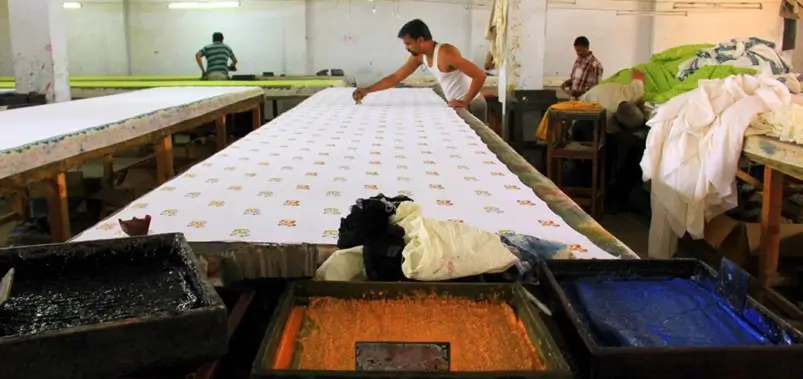
A visit to a block printing workshop Jaipur travellers can access typically reveals a process with considerably more steps than most visitors expect, several of which happen well before any printing actually begins.
Fabric Preparation
Raw fabric must first be prepared to properly receive natural dyes. This often involves washing the cloth with a mixture that may include soda ash, sesame oil, and in traditional methods, cow dung, a step that seems unusual to outsiders but is essential for preparing the fabric's fibres. For Bagru printing specifically, fabric often then undergoes a harda treatment, where it is treated with the tannin rich harda fruit, giving it a yellowish base tone and, crucially, allowing the tannic acid to react with iron based dyes later in the process to produce the deep blacks characteristic of Bagru work.
Block Carving
The wooden blocks themselves are works of craft in their own right, carved from seasoned teak or sheesham wood by specialist block carvers, a skill distinct from printing itself. A single design might require several different blocks, each representing one colour or element of the pattern, carved with enough precision that they align perfectly when used in sequence.
The Printing Itself
This is the part most visitors find mesmerising. The printer works at a long padded table, loading a block with dye from a tray, then pressing it firmly and evenly onto the fabric, repeating this motion across the entire length of cloth, aligning each repeat of the pattern by eye with remarkable consistency. The rhythmic, percussive sound of block meeting fabric, a clean, wooden thud repeated again and again, is one of the most distinctive sensory elements of a workshop visit.
Dabu and Resist Techniques
For pieces using the dabu method, an additional layer of complexity is added: mud paste is applied through blocks to specific areas of the fabric before dyeing, creating a resist that prevents dye absorption in those areas. Once the mud dries and the fabric is dyed, the mud is washed away, revealing the original fabric colour beneath in the pattern of the resist, a technique that requires considerable skill to execute with precision.
Drying and Finishing
Printed fabric is laid out to dry, often outdoors, creating striking visual scenes of brightly patterned cloth stretched across open ground or hung in long rows. Depending on the dyes and technique used, fabric may also undergo boiling or additional washing stages before the final product is complete.
For travellers visiting a Chippa community workshop, most experiences follow a similar structure, typically beginning with transport from Jaipur to Bagru or Sanganer, roughly thirty kilometres each way, with the journey itself offering a glimpse of rural Rajasthan beyond the city.
On arrival, visitors are usually shown the various stages of the printing process in sequence, fabric preparation, block carving (sometimes demonstrated by a specialist carver separate from the printers), and the printing itself, often performed by artisans who have been doing this work for decades, sometimes from childhood.
Many workshops offer a hands on component, where visitors are given a block and fabric and guided through printing their own simple pattern, an experience that, even in its simplicity, gives genuine appreciation for the precision required to do this work at scale and speed.
Guided tours often include context beyond the technical process itself, the history of the Chippa community, the symbolism behind specific motifs, and the challenges the craft has faced and continues to face in balancing tradition with economic sustainability for the artisan families involved.
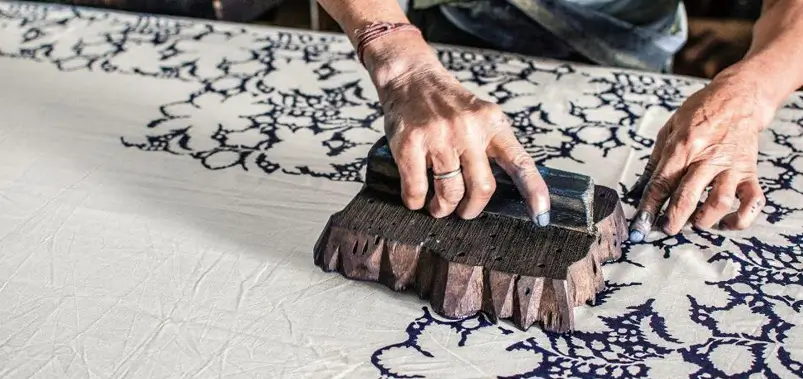
A workshop visit naturally leads to the question of what to buy, and hand block printing Jaipur textiles come in an enormous range of forms, far beyond simple yardage of fabric.
Common products include women's clothing (kurtas, tops, sarees, palazzos, skirts), men's shirts, home furnishings (cushion covers, bedsheets, quilts, table linens), fashion accessories (scarves, stoles, dupattas), and smaller items like notebooks, journals, and bags, all featuring hand printed fabric.
What to look for when buying: genuine hand block printing shows slight irregularities in registration between colours, no two repeats across a length of fabric will be perfectly identical, since each press of the block is done by hand. The back of fabric printed with natural dyes typically shows visible dye penetration through the material. If a printed pattern looks mechanically perfect, with flawless, identical repeats throughout, it has likely been screen printed or digitally printed rather than hand block printed, regardless of how it is marketed.
Buying directly from workshops in Bagru or Sanganer, or from contemporary brands that source directly from these artisan communities, often provides both better assurance of authenticity and more direct support for the artisan families producing the work
Explore Jaipur's Rich Art, Craft & Cultural Traditions
Immerse yourself in Jaipur's vibrant creative heritage by visiting traditional craft villages, artisan studios, colorful local markets, and historic landmarks. Travel with a private chauffeur and enjoy an authentic cultural journey designed around your interests and schedule.
Beyond the practical value of understanding what you are buying, a visit to a Chippa community workshop connects to something larger: the preservation of a centuries old craft that has, at multiple points, come close to disappearing entirely.
Many of the workshops welcoming visitors today operate explicitly with this preservation in mind, combining tourism with efforts to support the socio economic wellbeing of artisan families and to pass these skills to younger generations who might otherwise leave the craft for other work. For travellers, this transforms a craft visit into something with genuine impact, an afternoon of cultural curiosity that, through purchases and through simply valuing and learning about the work, contributes to a tradition's continuation.
We promise you a holiday where everything is taken care of from the moment you land. Trusted drivers waiting for you, handpicked hotels that fit your style, personalized itineraries designed just for your family, and a dedicated team on call 24/7. All you need to do is relax, explore, and create unforgettable memories, while we take care of every detail behind the scenes.
Yes. The use of natural dyes and traditional, low-impact production methods makes hand block printing a notably sustainable alternative to mass-produced, synthetically dyed textiles.
Yes. A visit to Bagru or Sanganer can often be combined with other stops along the route, depending on the itinerary, making it a flexible addition to a day of exploring beyond central Jaipur.
Printing blocks are traditionally carved from seasoned teak or sheesham wood, chosen for their durability and suitability for fine detail carving.
Buying directly from workshops in these towns, or from brands that source directly from them, often provides stronger assurance of authenticity and more direct support for the artisans.
Industrialisation and the rise of synthetic dyes and machine printing in the twentieth century significantly reduced demand for traditional hand block-printed textiles, threatening the livelihoods of artisan families.
A workshop visit, including transport to and from Jaipur, typically takes a half day to a full day, depending on the depth of the experience and any additional stops included.
Yes. Workshop visits are generally accessible for travellers of all ages and interests, combining a cultural and historical experience with an optional hands-on activity.
Traditional Bagru printing uses natural dyes derived from sources such as harda (a tannin-rich fruit), pomegranate, and indigo.
Products range from clothing such as kurtas, sarees, and palazzos, to home furnishings like bedsheets and cushion covers, as well as accessories, scarves, bags, and stationery items.
Genuine hand block-printed fabric shows slight irregularities in colour registration between repeats, with no two patterns perfectly identical, and visible dye penetration on the reverse side for naturally dyed pieces.
Yes. Many workshops offer hands-on sessions where visitors are guided through printing a simple pattern themselves using traditional blocks and dyes.
Dabu is a mud-resist printing method where mud paste is applied to specific areas of fabric before dyeing, preventing dye absorption in those areas and creating distinctive patterns once the mud is washed away.
Bagru is located approximately thirty kilometres from Jaipur, generally accessible as a half-day or full-day excursion.
Bagru printing features bold, earthy geometric and nature-inspired motifs on off-white or beige backgrounds using natural dyes, often incorporating the mud-resist dabu technique. Sanganeri printing features delicate floral patterns on predominantly white backgrounds, reflecting Mughal influences.
The Chippa community is known for hand block printing, a traditional textile craft using hand-carved wooden blocks and natural dyes, practiced for centuries in towns near Jaipur, particularly Bagru and Sanganer.