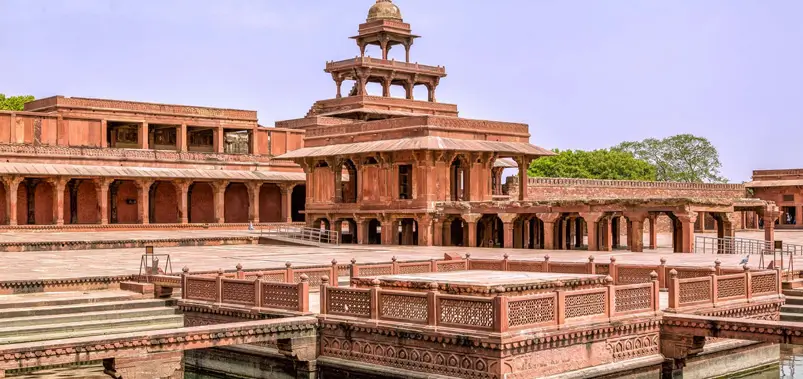
Just 40 kilometres west of Agra, Fatehpur Sikri stands as one of India's most extraordinary historical destinations. Once the magnificent capital of the Mughal Empire, this UNESCO World Heritage Site is often described as a "ghost city" because it served as the imperial capital for only a short period before being abandoned. Today, its remarkably preserved palaces, courtyards, mosques, gateways, and royal residences allow visitors to step back into the golden age of Emperor Akbar.
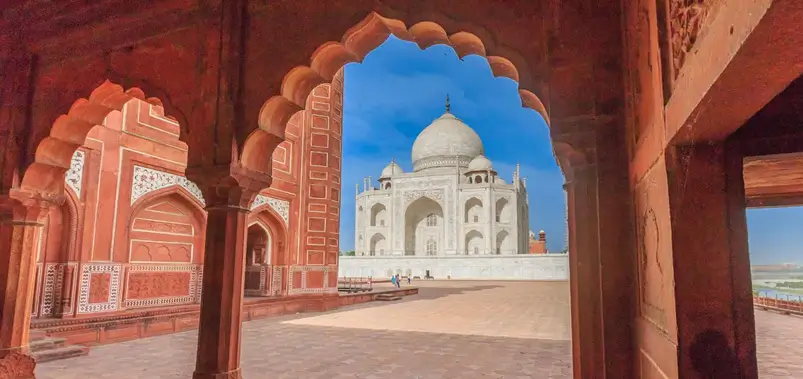
Many travellers visiting the Taj Mahal are unaware that one of the most significant Mughal cities lies less than an hour away. While the Taj Mahal showcases the architectural brilliance of Emperor Shah Jahan, Fatehpur Sikri tells the story of Akbar the Great, the ruler who transformed the Mughal Empire into one of the world's most powerful kingdoms through military expansion, cultural integration, and architectural innovation.
Unlike Agra's bustling tourist areas, Fatehpur Sikri offers a slower and more immersive historical experience. Walking through its wide courtyards and sandstone palaces, visitors can imagine the daily life of the Mughal court, where emperors held royal audiences, scholars debated philosophy, musicians performed for the emperor, and ambassadors from distant kingdoms arrived to negotiate alliances.
The city is celebrated for its remarkable blend of Persian, Central Asian, Islamic, and Indian architectural styles. Massive gateways stand beside intricately carved palaces, elegant pavilions overlook peaceful courtyards, and delicate stone screens demonstrate the extraordinary craftsmanship of sixteenth century artisans.
A visit to Fatehpur Sikri is not simply an excursion from Agra—it is an opportunity to understand how the Mughal Empire evolved before the construction of the Taj Mahal. The city's monuments reveal Akbar's political vision, religious tolerance, and passion for architecture in a way that few other sites in India can match.
This complete guide explains everything you need to know before planning a Fatehpur Sikri day trip from Agra, including travel options, opening hours, ticket prices, major attractions, photography tips, and practical advice for making the most of your visit.
The story of Fatehpur Sikri begins in the late sixteenth century with Emperor Akbar.
Despite ruling one of the largest empires in the world, Akbar remained deeply concerned that he had no heir to continue the Mughal dynasty.
Seeking spiritual guidance, he visited the revered Sufi saint Sheikh Salim Chishti, who lived in the small village of Sikri. The saint reportedly predicted that Akbar would soon be blessed with a son.
When Akbar's son—later Emperor Jahangir—was born, the emperor regarded the prediction as a divine blessing.
To honour the saint and celebrate the birth of his heir, Akbar decided to build an entirely new imperial capital at Sikri.
Construction began around 1571, and within only a few years an extraordinary royal city had emerged.
The new capital included:
At its height, Fatehpur Sikri became one of the most impressive planned cities of the Mughal Empire.
.webp)
Perhaps the most fascinating aspect of Fatehpur Sikri is that it served as the Mughal capital for only about 14 years.
Historians continue to debate the exact reasons for its abandonment.
Several factors likely contributed.
One widely accepted explanation is the city's limited water resources.
Supporting a large imperial population proved increasingly difficult as demand grew.
As the Mughal Empire expanded toward north western India, Akbar required a capital closer to military frontiers.
Eventually, administrative priorities shifted elsewhere.
Moving the imperial court provided greater flexibility for governing the rapidly growing empire.
Although abandoned as the permanent capital, Fatehpur Sikri never completely disappeared.
Its extraordinary sandstone buildings survived remarkably well, allowing modern visitors to experience one of the best preserved Mughal cities in India.
One of the greatest advantages of visiting Fatehpur Sikri is its proximity to Agra.
|
Route |
Distance |
|---|---|
|
Agra to Fatehpur Sikri |
Approximately 40 km |
Average journey time:
45–60 minutes, depending on traffic.
The most convenient option.
Advantages include:
Approximate cost:
₹2,500–₹5,000 for a return trip, depending on the vehicle.
Taxis are widely available throughout Agra.
Visitors may hire:
Government and private buses regularly connect Agra with Fatehpur Sikri.
Approximate fare:
₹100–₹250
Although economical, buses are generally less comfortable than private transport.
Fatehpur Sikri is open throughout the year.
|
Information |
Details |
|---|---|
|
Opening Time |
6:00 AM |
|
Closing Time |
6:00 PM |
|
Open Days |
Every Day |
The best time to arrive is early morning when temperatures remain pleasant and photography conditions are excellent.
|
Visitor Category |
Ticket Price |
|---|---|
|
Indian Citizens |
₹50 |
|
Foreign Tourists |
₹610 |
|
Children |
As per current government regulations |
Visitors entering the Jama Masjid and the Tomb of Sheikh Salim Chishti should dress respectfully, as these remain important religious sites.
Although the entire complex is impressive, several monuments stand out as essential highlights.
Standing approximately 54 metres high, Buland Darwaza is one of the tallest ceremonial gateways in the world.
Built to commemorate Akbar's victory over Gujarat, this monumental entrance dominates the skyline and provides one of the most iconic photographs in Fatehpur Sikri.
Its enormous sandstone façade, decorated with marble inlay and Quranic inscriptions, demonstrates the ambition of Mughal architecture at its peak.
Located beyond Buland Darwaza, the Jama Masjid remains one of India's most important Mughal mosques.
Its vast courtyard continues to welcome worshippers and visitors alike, creating an atmosphere that blends history with living tradition.
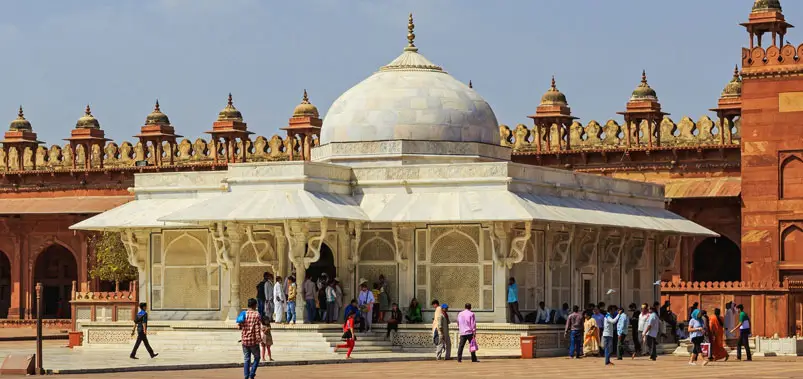
At the heart of Fatehpur Sikri stands one of its most sacred and spiritually significant monuments—the Tomb of Sheikh Salim Chishti.
Unlike the surrounding red sandstone buildings, this beautiful shrine is constructed almost entirely of white marble, creating a striking visual contrast against the rest of the complex.
The tomb was built in honour of the revered Sufi saint whose blessing, according to Mughal tradition, led to the birth of Emperor Akbar's long-awaited son, Prince Salim, who later became Emperor Jahangir.
Today, the shrine continues to attract thousands of pilgrims from across India and around the world.
Many visitors participate in a local tradition by tying a thread to the intricately carved marble lattice screens (jali work) while making a personal wish or offering a silent prayer. Although this custom is widely followed, it is entirely optional and should always be approached respectfully.
Architectural highlights include:
Visitors should remove their shoes before entering the shrine and dress modestly, as it remains an active place of worship.
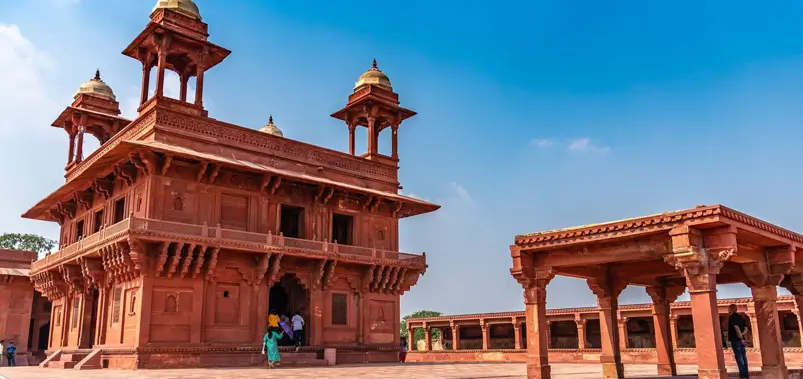
Among the most fascinating buildings inside Fatehpur Sikri is the Diwan-i-Khas, where Emperor Akbar met distinguished guests, foreign ambassadors, scholars, and senior ministers.
From the outside, the building appears relatively simple, but the interior contains one of Mughal India's most extraordinary architectural features.
At the centre stands an elaborately carved stone pillar supporting a circular platform connected to the surrounding galleries by four narrow stone bridges.
Historians believe this platform symbolised Akbar's central role in governing his empire, while others suggest it was used during philosophical and religious discussions that reflected the emperor's interest in different faiths and cultures.
The craftsmanship of the central pillar is exceptional, featuring:
This hall is often regarded as one of the finest examples of Akbar's innovative architectural vision.
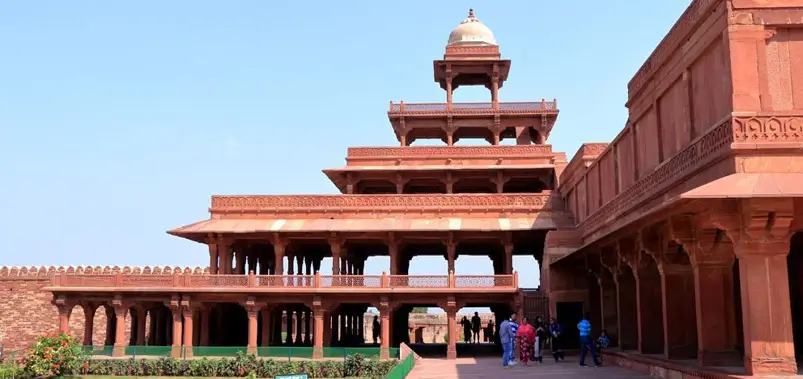
One of the most recognisable structures in Fatehpur Sikri is the Panch Mahal, a graceful five storey pavilion built almost entirely with open columns.
Unlike enclosed royal palaces, Panch Mahal was designed to maximise airflow, making it a comfortable retreat during the hot summer months.
The structure gradually decreases in size with each level, giving it a distinctive pyramidal appearance.
Originally, the pavilion is believed to have served as a leisure space for members of the royal household, offering panoramic views of the surrounding city and countryside.
The open design allows sunlight and fresh air to flow freely through the building, demonstrating how Mughal architects successfully adapted their designs to India's climate.
Photography from the surrounding gardens beautifully captures the symmetry and elegance of this remarkable structure.
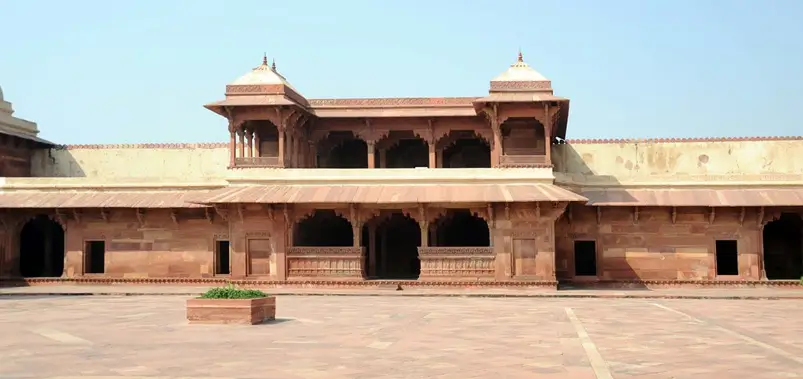
One of the largest residential complexes within Fatehpur Sikri is commonly known as Jodha Bai's Palace.
Although historians continue to debate its exact historical association, the palace remains one of the city's most impressive architectural achievements.
The residence combines elements of:
Large courtyards, beautifully carved balconies, decorative gateways, and richly ornamented pillars illustrate the cultural diversity that characterised Akbar's reign.
Walking through the palace provides valuable insight into the luxurious lifestyle enjoyed by the Mughal royal family.
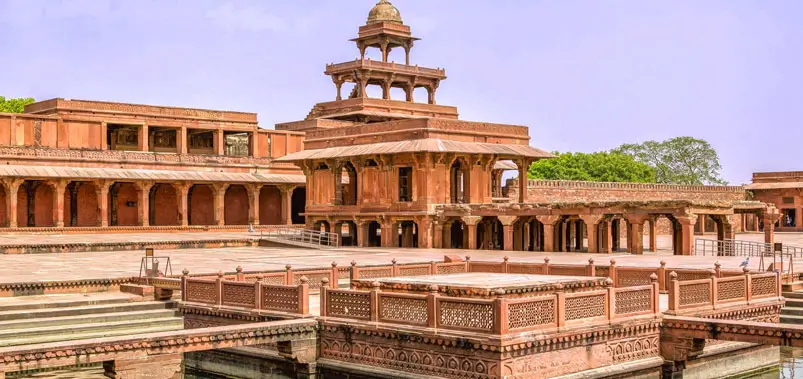
Situated near several important palace buildings, Anup Talao is a square ornamental pool with a raised central platform connected by narrow stone bridges.
Historical accounts suggest that the platform hosted musical performances, poetry recitals, and intellectual discussions attended by Emperor Akbar and his court.
The famous musician Tansen, one of Akbar's legendary "Navratnas" (Nine Gems), is believed to have performed here.
Today, the reflecting water and symmetrical layout make Anup Talao one of the most photogenic locations within Fatehpur Sikri.
Fatehpur Sikri offers outstanding opportunities for architectural and travel photography.
The monumental gateway looks particularly impressive when photographed from the lower steps, emphasising its enormous scale.
Early morning light enhances the warm tones of the red sandstone.
Its layered architecture creates striking geometric compositions from multiple angles.
Reflection photography works especially well here during calm weather.
Beautiful courtyards and intricately carved doorways provide excellent portrait backgrounds.
The contrast between white marble and surrounding sandstone creates elegant photographs unlike any other monument in the complex.
Most visitors require approximately 3–4 hours to explore Fatehpur Sikri comfortably.
|
Time |
Activity |
|---|---|
|
8:00 AM |
Arrive at Fatehpur Sikri |
|
8:15 AM |
Buland Darwaza |
|
8:45 AM |
Jama Masjid |
|
9:15 AM |
Tomb of Sheikh Salim Chishti |
|
9:45 AM |
Diwan-i-Khas |
|
10:15 AM |
Panch Mahal |
|
10:45 AM |
Jodha Bai's Palace |
|
11:30 AM |
Anup Talao and surrounding courtyards |
|
12:00 PM |
Return to Agra or continue sightseeing |
This itinerary allows enough time for photography, short breaks, and appreciating the architectural details without feeling rushed.
A little preparation will make your visit much more comfortable.
Before arriving:
Hiring a government approved guide is worthwhile for visitors interested in Mughal history, as many fascinating stories are not explained on the information boards alone.
Some organised tours allow less than two hours at Fatehpur Sikri.
The complex deserves at least three hours for a meaningful visit.
From April to June, temperatures can exceed 40°C.
Morning visits are considerably more comfortable.
The complex covers a large area with extensive walking on stone pathways.
Supportive shoes make a noticeable difference.
Many visitors focus only on Buland Darwaza and the mosque.
Palaces such as Panch Mahal and Diwan-i-Khas are equally important and should not be overlooked.
The Tomb of Sheikh Salim Chishti and Jama Masjid remain active religious sites.
Visitors should dress modestly, remove shoes where required, and maintain respectful behaviour.
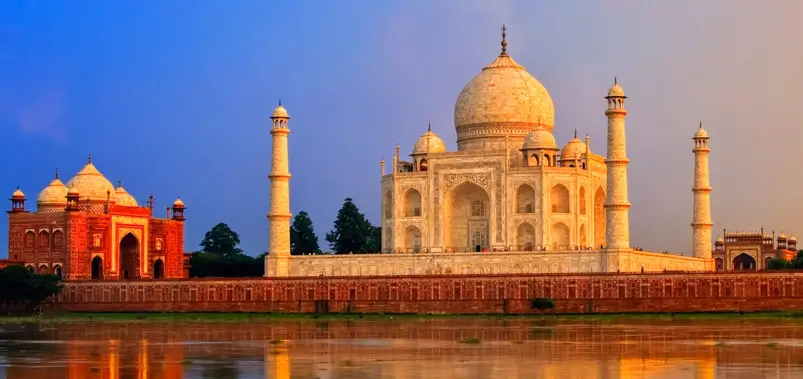
If time allows, several attractions can easily be combined with a Fatehpur Sikri excursion.
|
Attraction |
Approximate Distance |
|---|---|
|
Taj Mahal |
40 km |
|
Agra Fort |
37 km |
|
Itmad-ud-Daulah's Tomb |
42 km |
|
Mehtab Bagh |
43 km |
|
Bharatpur Bird Sanctuary |
Approximately 25 km |
Travellers with a full day available often combine Fatehpur Sikri with Agra's major monuments for a comprehensive exploration of Mughal history.

We promise you a holiday where everything is taken care of from the moment you land. Trusted drivers waiting for you, handpicked hotels that fit your style, personalized itineraries designed just for your family, and a dedicated team on call 24/7. All you need to do is relax, explore, and create unforgettable memories, while we take care of every detail behind the scenes.
Because it served as the Mughal capital for only about 14 years before being largely abandoned, leaving behind one of the world's best-preserved historic imperial cities.
Absolutely. Families with children can comfortably explore the site, although carrying water and sun protection is recommended.
Yes. It remains an important Sufi pilgrimage site, and visitors should behave respectfully while inside the shrine.
Yes. Government-approved guides are available near the entrance and provide valuable historical context.
The period from October to March offers the most pleasant weather for walking and sightseeing.
Yes. Photography is permitted in most public areas, making the site excellent for architecture and travel photography.
Yes. Many travellers combine Fatehpur Sikri, Agra Fort, and even the Taj Mahal within a full-day itinerary.
Most visitors should allow 3–4 hours to explore the complex comfortably.
The distance is approximately 40 kilometres, and the journey usually takes 45–60 minutes by road.
Yes. It is one of India's finest UNESCO World Heritage Sites and provides an exceptional insight into Emperor Akbar's reign and Mughal architecture.