Let us start with something most travel blogs will not tell you. Elephant Village Jaipur, also known as Haathi Gaon, is one of the most talked about elephant experiences in Rajasthan and also one of the most misunderstood. Some tourists leave calling it the best experience of their India trip. Others leave furious, having paid five to ten times the fair price after being dropped there by a commission hungry driver.
The difference between those two outcomes is almost entirely about preparation.
This guide will tell you exactly what Haathi Gaon is, what actually happens there, what things cost, which scams to watch for, and how to have a genuine and meaningful experience without getting taken advantage of. If you are a foreign tourist planning to visit Jaipur, read this before you book anything.
.webp)
Haathi Gaon translates literally to Elephant Village. It is a purpose built settlement located approximately 4 kilometres from Amber Fort on the outskirts of Jaipur, created by the Rajasthan government specifically to house elephants and their mahout (elephant caretaker) families.
Hathi Gaon, also known as Elephant Village Jaipur, is India's first planned elephant settlement, created to provide better living conditions for elephants and their caretakers. The village was developed to replace older systems where elephants were kept in crowded or unsuitable spaces.
It is believed that Jaipur had an Elephant Cavalry, and the men who rode them used to live in this area. The village has been attracting travellers for over 60 years, and from 2006, many local Indian travellers also started visiting. In 2017, the Rajasthan Forest Department designated Hathi Gaon as a tourist attraction, promoting it as an elephant safari destination in Jaipur.
The key thing to understand about Haathi Gaon is that it is not a single business. It is a community — a collection of mahout families who each own and care for their own elephants. After 2010, many local homes in Hathi Gaon opened elephant safari tours, where they offer 15 to 30 minute elephant rides on their farms, and guests can also feed elephants and have them create a painting.
This means there is no single price list, no single booking desk, and no standardised experience across the entire village. Different families run different setups. Quality, pricing, and ethics vary significantly from one operator to the next. This is the root cause of almost every problem foreign tourists encounter here.
Foreign tourists arriving at Haathi Gaon for the first time are often surprised by what they find. Travel content online tends to show beautiful photographs of painted elephants and joyful interactions. The reality is more complicated.
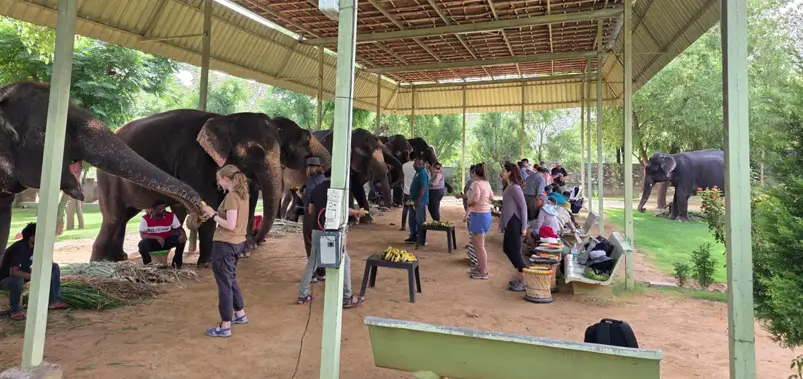
When you enter the area, nothing in there looks like a sanctuary in the traditional sense. There is barren land and in some sections, filthy water. When you reach the operator area, it is a small open structure with plastic chairs around it — it does not look like what most visitors expect.
The elephants themselves are there. They are large, they are real, and being close to them is genuinely remarkable regardless of the setting. But the environment around them is a working village, not a polished tourist attraction. Some sections are well maintained; others are not. Managing expectations before you arrive is important.
The official visiting hours are 9:30 AM to 6:30 PM as listed on Rajasthan's state tourism portal. Most visitor activity happens in the afternoon window because mornings are often spent with elephants at Amber Fort. Elephants are usually back from Amber Fort around 12:00 PM to 6:00 PM.
For this reason, early morning visits are not necessarily better at Haathi Gaon — the elephants may not yet be back. If you are pairing Haathi Gaon with Amber Fort in the morning, you will naturally arrive in the 12:00 to 3:00 PM window, which is actually good for seeing more elephants around the village.
.webp)
Depending on which operator you visit within the village, the following activities are generally available.
Elephant feeding is the most basic interaction. You are given sugarcane, fruits, or other food to offer directly to the elephant. The elephant's trunk wrapping around your hand to accept food is one of those physical moments that stays with you.
Walking with the elephant means walking alongside or slightly behind the elephant as a mahout leads it through the village grounds. This is one of the more natural and less commercial feeling interactions available.
Elephant bathing involves participating in washing the elephant in a designated water area. This is typically the most joyful and chaotic part of any elephant interaction experience. You will get wet.
Elephant painting is the traditional practice of decorating the elephant with natural colours. At well run operators this is done gently; at poorly run ones, it can feel rushed and perfunctory.
Elephant rides, which involve sitting on the elephant's back, are available at some operators within Haathi Gaon. This is where the ethical question becomes most pointed, and where the most pricing controversy exists. More on this below.
Photography packages are offered by many operators, where a photographer follows you through the interaction and captures images on your device.
This is the section most travel blogs avoid because the pricing at Haathi Gaon is genuinely inconsistent and often heavily inflated for foreign tourists. Here is what the data from real visitor reports shows.
Official entry fee to Haathi Gaon: Entry ticket: approximately Rs. 100 for Indian visitors and Rs. 350 for foreign tourists. This is the park entry fee, separate from any activities.
Elephant interaction packages: Elephant feeding and interaction typically costs Rs. 500 to Rs. 1,000. Bathing and scrubbing the elephant costs Rs. 1,000 to Rs. 1,500. Most visitors prefer a combo package to enjoy multiple activities at a discounted rate.
Elephant rides: The government has fixed rates for rides at approximately Rs. 1,000 to Rs. 1,500 per ride, but some visitors claim they were charged differently and were promised 30 minutes but sometimes received only 15.
Premium packages: Premium packages start at Rs. 4,500 per person and include hotel pick up and drop off, elephant painting sessions, and extended interaction experiences.
Now here is the honest part. A guide or driver may take you to Haathi Gaon claiming it is the proper elephant sanctuary in Jaipur. Once there, some operators quote Rs. 15,500 per person for the same types of activities available elsewhere for Rs. 4,500, including a meal. When visitors look shocked, prices immediately drop, and operators offer to log them as Indian visitors to get a better price.
This kind of dynamic, where the opening price is completely detached from any legitimate cost, is the most common complaint from foreign tourists who visit Haathi Gaon without preparation.
.webp)
This is the single most important thing a foreign tourist visiting Haathi Gaon needs to understand.
Taxi drivers and guides may steer tourists to Haathi Gaon for commission. Travellers report being quoted around Rs. 100 to Rs. 110 per person for entry, but official receipts are often not provided. Prices can vary significantly and may be inflated by guides or drivers seeking commissions.
Drivers begin this scam by casually asking "would you like to see the elephants?" on the way between destinations. The driver then calls ahead, and two minutes later takes a left turn into the compound. Once inside, visitors are greeted by an operator who begins by quoting Rs. 20,000 for two people, then drops to a "student rate" of Rs. 14,000.
The mechanism is simple. Your driver gets a percentage cut of whatever you pay. The higher the price you pay, the more the driver earns. The operator and driver work together. You are the product.
How to protect yourself:
Book directly, not through your driver. If you want to visit Haathi Gaon, book an activity independently before you get in the vehicle. Use the official website of a specific reputable operator, or book through a verified platform like GetYourGuide or Viator where prices are published in advance.
Know the price before you enter. Confirm both the duration and price in advance to avoid misunderstandings. If an operator will not give you a clear written price before the activity begins, leave.
Do not feel trapped. Some visitors feel trapped once inside the compound and believe they must pay whatever is asked because they are outnumbered or in an unfamiliar environment. You can always leave. Walking back to the main road and calling an Ola or Uber is always an option.
Compare prices with Elefantastic or other established sanctuaries. If someone is quoting you Rs. 10,000 or more for an hour of interaction that a fully reviewed ethical sanctuary offers for Rs. 4,500 to Rs. 5,500, that is a red flag.
Foreign tourists who have read about ethical elephant tourism before visiting Jaipur often arrive with questions about Haathi Gaon's practices. These are legitimate questions and deserve an honest answer.
Many guests mistakenly believe Haathi Gaon is an elephant sanctuary with retired or rescued circus elephants, which is incorrect. All the elephants here are born and raised in this village, creating a strong connection with their owners.
This is an important distinction. The elephants of Haathi Gaon are not rescued animals in the sense that Elefantastic's are. They are working elephants, owned by mahout families, some of whom use them at Amber Fort and for tourism income. This is not inherently wrong — it is the economic reality of elephant keeping in Rajasthan — but it is different from what some visitors expect.
Unlike traditional tourist spots, Elephant Village at its better operators prioritises elephant welfare. Rides are shorter and gentler, with strict limits on daily rides to prevent exhaustion.
The quality of care varies significantly between individual families within the village. Some mahouts have deep multigenerational bonds with their elephants and treat them with obvious affection. Others run operations that are purely transactional. As a visitor, you cannot always tell which you are entering before you go in, which is why researching specific operators — not just Haathi Gaon as a general destination — matters.
.webp)
Foreign tourists researching elephant experiences near Jaipur will inevitably encounter both Haathi Gaon and Elefantastic. Here is an honest comparison.
Elefantastic is a single, specific operator with a consistent ethical framework, published prices, a no riding policy, and thousands of verified international reviews. You know exactly what you are booking, what you will pay, and what the experience involves before you arrive. The tradeoff is that it requires advance booking and costs Rs. 4,000 to Rs. 5,500 per person.
Haathi Gaon is a community of multiple operators with inconsistent quality, inconsistent pricing, and a documented history of price gouging for foreign tourists. However, if you do your research and book a specific reputable family operation within the village in advance, the experience can be genuine and meaningful. The elephants here have been part of this community for generations, and at its best, Haathi Gaon offers something less curated and more real than any single operator sanctuary.
The recommendation for most foreign tourists visiting Jaipur who want an ethical, hassle free elephant experience is to book Elefantastic. If you specifically want to visit Haathi Gaon, do so by booking a specific operator directly and knowing your prices before you arrive.
From Amber Fort, Haathi Gaon is approximately 4 kilometres away, taking 10 to 15 minutes by cab or auto without heavy traffic. From Jaipur city centre on MI Road, it is 13 to 16 kilometres, taking 30 to 45 minutes by cab depending on traffic.
Use Ola or Uber to get there independently rather than relying on a hired driver or rickshaw who may be working on commission. Book your cab from your hotel or from the Amber Fort area, input the destination yourself into the app, and pay through the app. This removes the driver commission incentive from the equation entirely.
If you are combining Haathi Gaon with an Amber Fort visit, plan for the afternoon rather than the morning to ensure the elephants are back in the village.
October through March is the most comfortable time to visit Jaipur overall, and this applies to Haathi Gaon as well. The outdoor activity is much more pleasant in cool weather, and the elephants are generally more relaxed.
Summer months from April through June are very hot. Any outdoor elephant interaction in 40 plus degree Celsius heat is genuinely uncomfortable and harder on the animals as well. If you are visiting in summer, go very early in the morning or after 4 PM.
For the best experience at Haathi Gaon, aim for an early morning visit around 8 AM. This is when you are most likely to see elephants bathing in the pond — a genuinely memorable sight. However, confirm with your operator in advance that elephants will be present at that time, as morning schedules vary based on Amber Fort duties.
Weekdays are significantly calmer than weekends. If you have flexibility in your schedule, a Tuesday or Wednesday visit will give you a far less crowded experience than a Saturday.
Wear clothes you are comfortable getting dirty and wet. Elephant interactions, especially bathing, guarantee some combination of water, mud, and elephant related substances on your clothing. Light cotton that dries quickly is ideal.
Closed toe shoes are strongly recommended. The village terrain is uneven and occasionally muddy.
Carry sunscreen and a hat. Most of the activity is outdoors with limited shade, and Rajasthan's sun is intense for most of the year.
Elephant ride prices can be high. Bargain hard and clarify costs upfront to avoid surprises. Carry some cash but do not carry more than you are willing to spend. Having a clear mental budget before you enter the village helps you hold your ground if prices are pushed upward.
Carry your own water. There are no reliable refreshment facilities inside the village.

We promise you a holiday where everything is taken care of from the moment you land. Trusted drivers waiting for you, handpicked hotels that fit your style, personalized itineraries designed just for your family, and a dedicated team on call 24/7. All you need to do is relax, explore, and create unforgettable memories, while we take care of every detail behind the scenes.
You can always leave. No one can physically prevent you from walking out. If prices quoted bear no relationship to what was advertised or agreed, refuse calmly, say you need to make a call, and exit the compound. Call Ola or Uber from outside the gate. Tourist Police in Jaipur can be reached at 0141-2744999 if you feel you need to report an incident.
No reliable food facilities exist inside the village. Some premium packages include a meal, but otherwise carry your own snacks and water. There are restaurants and dhabas along the road toward Amber Fort if you need food before or after.
Yes, children generally love it. The up-close nature of the elephant interaction is genuinely exciting for younger visitors. Ensure children stay close to the mahout and follow all instructions carefully around the animals.
Walk-in visits are technically possible, but not recommended for foreign tourists. Booking in advance through a specific operator's website or a verified platform removes the uncertainty around pricing and quality.
Know the standard price range before you enter: basic interaction packages run Rs. 500 to Rs. 1,500, and full experience packages run Rs. 3,000 to Rs. 5,000 at legitimate operators. If an operator opens negotiations at Rs. 10,000 or more for a basic package, they are testing how much you do not know.
It depends entirely on which operator you visit. Some mahout families have genuine multi-generational bonds with their elephants and treat them with care. Others run more commercial operations. Research your specific operator before visiting rather than assuming the entire village operates to the same standard.
Early morning around 8 AM for elephant bathing, or afternoon after 12 PM when elephants have returned from Amber Fort duties. Confirm with your specific operator what time works best for the activities you want.
Elefantastic is a single ethical operator with consistent pricing, a no-riding policy, and thousands of verified international reviews. Haathi Gaon is a community of multiple different family operators with inconsistent quality and pricing. Elefantastic is more predictable; Haathi Gaon is more variable.
Yes, some operators within the village offer elephant rides. Government-fixed rates are approximately Rs. 1,000 to Rs. 1,500 per ride, but operators have been documented charging foreign tourists far more than this. Confirm the price and duration in writing before agreeing to anything.
They can, but be cautious. Many drivers receive commissions from specific operators within the village and will take you to whoever pays them the highest cut, not to the best or most ethical option. Book your specific operator in advance rather than letting a driver choose for you.
The government-designated entry fee is approximately Rs. 320 to Rs. 350 for foreign tourists. Any amount significantly higher than this quoted as an "entry fee" is not an official government charge.
It can be, if you go in with realistic expectations and book a specific trusted operator in advance. It is not a polished tourist attraction. It is a working mahout community. If that context appeals to you and you are prepared to navigate pricing carefully, it can be a genuinely interesting experience.