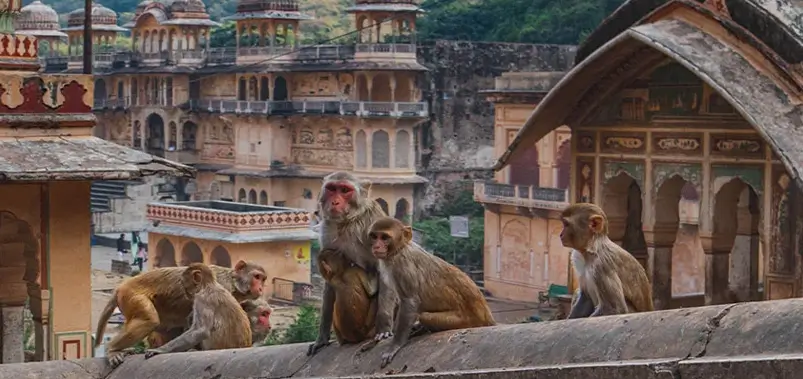
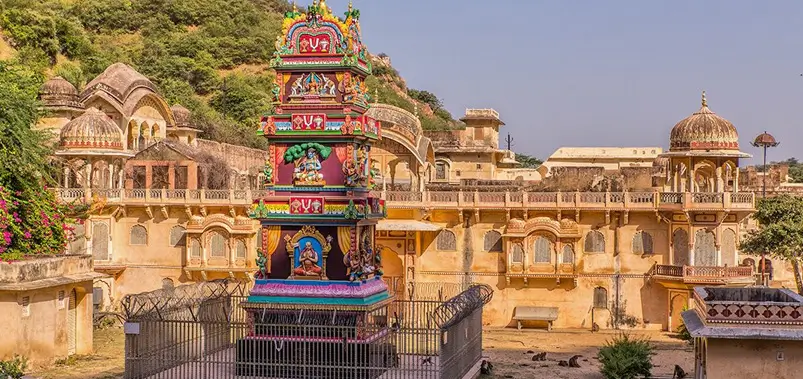
Jaipur has no shortage of famous sights. The Amber Fort, Hawa Mahal, City Palace — every tourist itinerary has them. But tucked away in a rocky gorge about 10 kilometres east of the old city is a place that feels genuinely different. Galta Ji, known popularly as the Monkey Temple Jaipur, is one of those rare spots where ancient Hindu pilgrimage tradition, wild monkeys, natural spring water, and pink sandstone architecture all exist together in one compact valley.
Most foreign tourists show up here with a camera and thirty minutes to spare. They leave having experienced something they cannot quite explain. Some find it magical. Some find it overwhelming. A few find it uncomfortable. Almost all of them say they are glad they came.
This guide will tell you exactly what Galta Ji is, what actually happens there, how to visit respectfully, and how to stay safe around the monkeys — because yes, that is a real consideration.
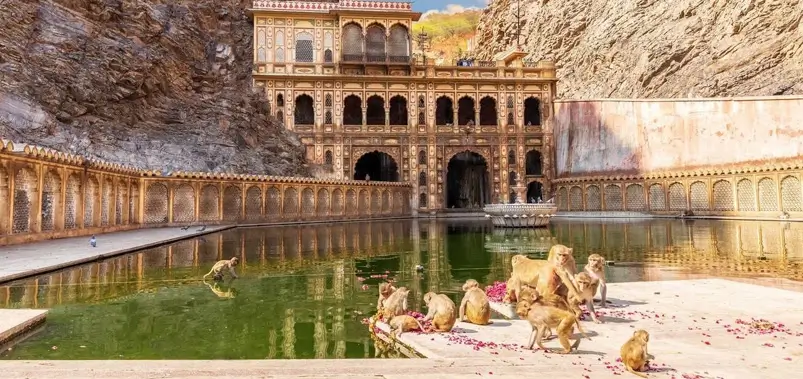
The name Monkey Temple was invented by tourists, not by locals. To the people of Jaipur, this place is Galta Ji Tirth, a sacred Hindu pilgrimage site that has existed in some form since at least the 8th century. The temples and tanks you see today were largely built in the 18th century by a nobleman in the court of Maharaja Sawai Jai Singh II.
The site is dedicated primarily to the sun god Surya and the saint Galav, who is said to have meditated here for years. According to legend, his devotion caused a natural spring to emerge from the rocks, and that spring still feeds the sacred kunds (water tanks) to this day.
The monkeys have always been here. Rhesus macaques consider Galta Ji their home. They swim in the kunds, sit on the temple rooftops, chase each other through the pavilions, and occasionally steal food from pilgrims. In Hindu tradition, monkeys are associated with Lord Hanuman, so their presence at a temple is considered auspicious, not unusual. Nobody shoos them away. Nobody tries to control them. They are simply residents, and you are the visitor.
Understanding this dynamic before you arrive changes how you experience the whole place.
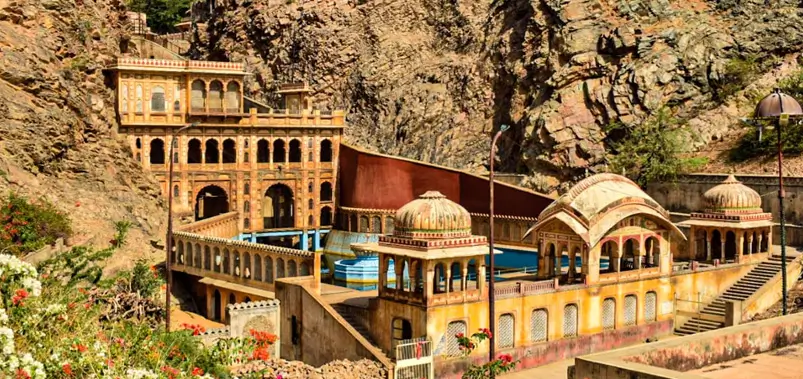
Galta Ji is not a single temple. It is a complex of multiple temples and structures spread across a narrow valley cut into the Aravalli Hills. As you walk in from the main entrance, here is roughly what you will encounter.
The path leading into the gorge is lined with small stalls selling flowers, coconuts, and prasad (devotional offerings) for pilgrims. You will also see vendors selling bananas and peanuts marketed specifically toward tourists who want to feed the monkeys. More on why you should think twice about that later.
As you go deeper, the valley opens up into a series of sacred kunds — large rectangular tanks fed by natural spring water. The most important of these is the Galta Kund, considered especially holy. Hindu pilgrims come here to bathe, believing the water has purifying properties. On auspicious days and festivals, the kunds fill with hundreds of bathers.
Above the kunds, built right into the cliff face, are the main temples. The Surya Temple at the top of the complex offers a panoramic view over Jaipur city from the ridge above — this viewpoint is one of the best and least photographed in the entire city. Getting up there requires a climb, but it is absolutely worth it.
Throughout the complex, monkeys are everywhere. On the rooftops, beside the kunds, on the pathways, sitting on top of idols. You will be walking among them, not observing them from a distance. This is the reality of Galta Ji that no tourism brochure quite prepares you for.
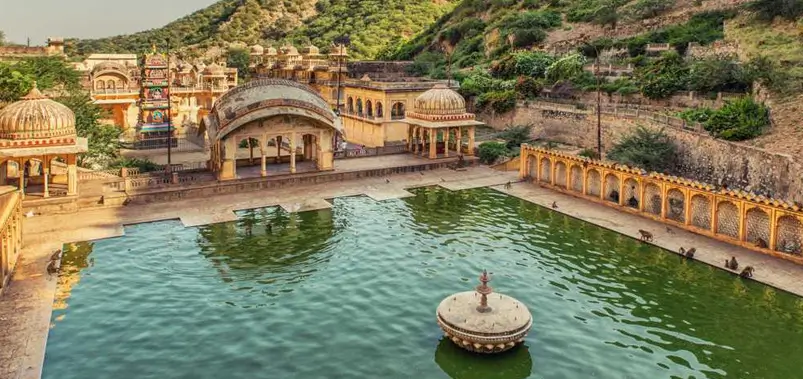
Galta Ji is located approximately 10 kilometres east of the Hawa Mahal and the old city area. It sits at the edge of the Aravalli Hills, and the road leading to it passes through a residential neighbourhood before climbing slightly toward the gorge entrance.
By auto-rickshaw: This is the most practical option for most tourists. From the old city or any central hotel, expect to pay between 150 and 250 rupees one way. Always agree on the price before you get in. Some drivers will quote a higher price for the return trip if they wait for you, which is usually worth negotiating upfront. Make sure your driver knows you want Galta Ji Tirth, not just "Monkey Temple," as the latter sometimes causes confusion.
By taxi or cab app: Ola and Uber both operate in Jaipur and work reliably. A cab from the old city to Galta Ji typically costs 200 to 350 rupees depending on traffic and time of day. This is the easiest option if you want door to door comfort.
By rental scooter or motorcycle: If you are comfortable riding in Indian traffic, renting a scooter gives you complete flexibility. Jaipur traffic can be chaotic, but the road to Galta Ji is relatively straightforward. Several rental shops operate near the old city.
By public bus: City buses do run toward Galta Ji, but the routes change frequently and stops are not always well marked in English. Unless you enjoy a bit of adventure with your travel, this is not recommended as a first option for foreign tourists visiting Jaipur.
There is limited parking near the entrance if you have a private vehicle, but it fills up quickly on weekends and festival days.
Timing your visit makes an enormous difference at Galta Ji.
Early morning, between 6 AM and 8 AM, is by far the best time. The light in the gorge is soft and golden, the monkeys are active but not agitated, the pilgrims are fewer, and the temperature is pleasant even in summer. This is also the time when you are most likely to see the morning aarti (prayer ritual) at the main temple, which is a genuinely moving experience.
Late afternoon, from about 4 PM to 6 PM, is the second best window. The harsh midday light is gone, the heat has dropped, and there is a calm, golden quality to the valley that feels completely different from the busy middle of the day.
Avoid visiting between 11 AM and 3 PM if you can. In summer (April through June), the gorge becomes very hot, the monkeys become more aggressive in the heat, and the midday crowds are at their peak.
In terms of seasons, the best months to visit Jaipur overall are October through March. The weather is cool and comfortable, and the light is excellent for photography. The Galta Ji temple in winter has a completely different character compared to the harsh summer months.
If you happen to be in Jaipur during Makar Sankranti (January) or certain other Hindu festivals, Galta Ji gets very crowded with pilgrims. This is fascinating to witness but requires more patience and a more cautious approach to navigating the space.
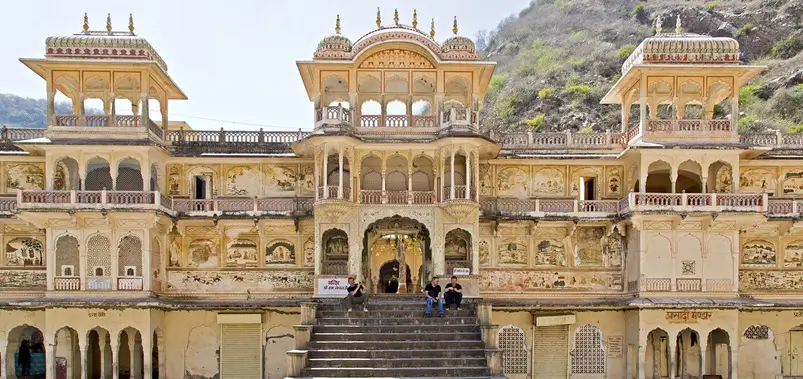
Galta Ji is an active Hindu religious site. Dress accordingly.
Both men and women should cover their shoulders and knees at a minimum. Sleeveless tops and shorts are not appropriate inside the temple complex. You do not need to wear traditional Indian clothing, but modest Western clothing works perfectly fine. Lightweight cotton works best given the heat in most of the year.
Remove your shoes before entering any of the actual temple structures. There will be shoe racks or spots to leave footwear near temple entrances. You can carry your shoes in a bag if you are worried about leaving them, though theft is uncommon.
Carry a scarf or light shawl regardless of what you are wearing. It is useful for covering up quickly, sitting on steps, and is generally practical inside temple spaces.
Do not wear expensive jewellery or accessories that are difficult to keep track of. Monkeys have been known to snatch shiny things.
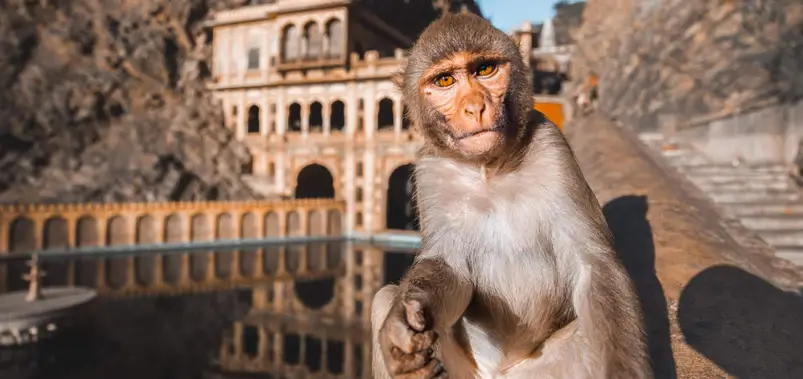
Let us be direct about this because most travel content is vague and unhelpful on the subject. The monkeys at Galta Ji can be unpredictable, and a small number of tourists do get scratched or bitten every year, usually because they did something that provoked the animal.
Here is what you need to know.
Do not feed the monkeys. We know this is the opposite of what the vendors at the entrance are selling you. But feeding creates dependence and aggression. A monkey that has been fed repeatedly by tourists is far more likely to snatch food aggressively from the next person. If you genuinely want to contribute to the animals, a donation to a local animal welfare organisation is a better use of your money.
Do not make direct eye contact with a monkey for a prolonged period. In monkey communication, sustained eye contact is a threat. If a monkey is staring at you, look away calmly and move on.
Do not come between a mother and her baby. Mother macaques are highly protective and will act defensively if they feel threatened.
Keep bags closed and held firmly. Monkeys will investigate any open bag with food smells. Zip up everything.
Do not run if a monkey approaches you. Stay calm, do not make sudden movements, and move away slowly. Running triggers a chase response.
If you are scratched or bitten, wash the wound immediately with soap and water, and seek medical attention the same day. Rabies post exposure treatment is available in Jaipur and is highly effective when started promptly. This is not meant to alarm you — serious incidents are rare — but it is important information to have.
Most visitors walk through Galta Ji without any incident whatsoever. Common sense and calm behaviour are your best tools.
Galta Ji is one of the most photogenic sites in Jaipur and one of the least over photographed. Here is how to make the most of it.
The gorge itself has extraordinary light in the early morning, when shafts of sunlight cut through the narrow valley at angles. The pink sandstone glows in this light in a way that is almost surreal.
The viewpoint at the top of the ridge above the Surya Temple looks directly over Jaipur city. On clear winter days, you can see the Amber Fort in the distance. This view is almost never shown in standard Jaipur tourism content, which makes it genuinely worth the climb.
The kunds, especially when pilgrims are bathing, offer images that feel timeless and completely authentic. Always ask for permission before photographing individuals, particularly women who are bathing. Many pilgrims are comfortable being photographed; some are not. A smile and a questioning look is usually enough to gauge whether someone is happy to be photographed.
The monkeys themselves are endlessly photogenic, especially the babies. A longer zoom lens lets you capture them without getting too close.
Avoid using flash inside the temple structures. It disturbs both worshippers and monkeys.
Galta Ji entry is free for all visitors, domestic and foreign. There is no ticket counter or admission charge to enter the complex.
However, you may encounter people near the entrance asking for a "donation" or "camera fee." These are not official charges. A small voluntary donation to the temple trust is entirely your choice, but you are not required to pay anything to enter.
Temple timings are approximately 5 AM to 9 PM, though the complex is technically open throughout the day. The main temples have their own prayer schedules, and some inner sanctums may be closed to non-Hindus during active rituals. Respectfully observe any signs or instructions from priests.
There are no restaurants inside the complex. Carry water with you, especially in summer. Small snack stalls operate near the entrance, but food options are limited.
Toilets are available near the entrance area but are basic. Use facilities at your hotel before visiting.
A typical visit takes 1.5 to 2.5 hours if you explore the full complex including the ridge viewpoint. Budget more time if you want to sit quietly, observe, and photograph at your own pace.
Galta Ji works well as a half morning activity, ideally combined with a visit to the nearby Sisodia Rani Garden or the Vidhan Sabha area on the way back toward the city.
If you are doing the classic Jaipur tourist circuit of Amber Fort, Nahargarh Fort, Hawa Mahal, and City Palace, Galta Ji sits slightly outside that loop but is worth dedicating a separate morning to. It is the kind of experience that slows you down in the best possible way.
It is also an excellent choice for travellers who have already done the major monuments and want something that feels more real, more lived in, and less curated for tourism.
We promise you a holiday where everything is taken care of from the moment you land. Trusted drivers waiting for you, handpicked hotels that fit your style, personalized itineraries designed just for your family, and a dedicated team on call 24/7. All you need to do is relax, explore, and create unforgettable memories, while we take care of every detail behind the scenes.
Carry water, a modest scarf or shawl, comfortable closed footwear that is easy to remove, and a small amount of cash. Leave expensive jewellery and open bags at the hotel. Sunscreen and a hat are strongly recommended between March and October.
The main lower area of the complex is relatively accessible, though surfaces are uneven in places. The upper sections, including the ridge viewpoint, require a climb up stone steps and would be difficult for people with significant mobility limitations.
Yes, photography is generally permitted in the complex. Ask for permission before photographing individuals, particularly during religious rituals or bathing. Avoid flash photography inside temple structures.
Yes. Monkeys move freely throughout the entire complex, including inside the temple structures. This is normal and expected. Keep your belongings secure and do not react with alarm.
October through March offers the most comfortable weather. Early morning visits during this period, with the winter light in the gorge, are genuinely beautiful. Summer months are very hot but still manageable if you visit early in the morning.
The kunds are sacred bathing tanks used by Hindu pilgrims. Foreign tourists are generally not expected to bathe in them. Observe respectfully from the edges. Do not enter the water unless you are certain it is appropriate in the specific context.
Galta Ji is approximately 10 kilometres from the Hawa Mahal. By auto-rickshaw or cab, the journey takes 20 to 35 minutes depending on traffic.
Wash the wound immediately with soap and running water for at least 15 minutes. Seek medical attention the same day. Rabies post-exposure prophylaxis is available in Jaipur and is highly effective when administered promptly. Do not ignore any animal bite.
No official entry fee exists. Any person asking for a mandatory fee near the entrance is not an official representative of the temple. A voluntary donation to the temple is a different matter entirely.
Yes. The complex is open to all visitors regardless of religion. Some inner temple sanctums may be restricted to Hindus during active worship, and these restrictions will usually be indicated at the entrance of the specific structure. Observe these respectfully.
No, you do not need a guide. The complex is compact and navigable on your own. However, a knowledgeable local guide can add significant depth to the experience by explaining the religious significance and history of the site. If you hire one, do so through your hotel or a certified agency rather than accepting offers from strangers at the entrance.
Yes, Galta Ji is generally safe. The main precaution is around monkey behaviour. Follow the guidelines in this article — do not feed them, do not provoke them, keep bags closed — and your visit will almost certainly be incident-free.