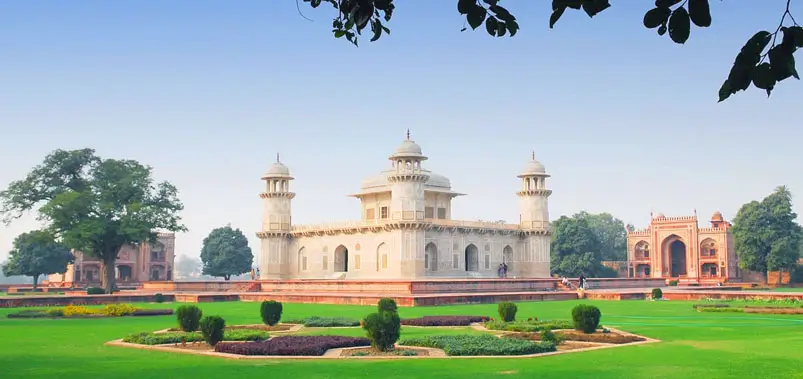
When travellers think of Agra, their minds immediately turn to the magnificent Taj Mahal—one of the Seven Wonders of the World and the city's greatest attraction. While the Taj Mahal undoubtedly deserves its global reputation, many visitors unknowingly miss another architectural masterpiece that quietly sits along the banks of the Yamuna River. Known affectionately as the Baby Taj, the Tomb of Itimad-ud-Daulah is one of Agra's most elegant Mughal monuments and an essential stop for anyone interested in history, architecture, or photography.
Despite being far smaller than the Taj Mahal, the Baby Taj holds extraordinary historical importance. Historians often describe it as the architectural predecessor of the Taj Mahal because many of the artistic techniques that later reached perfection in Shah Jahan's masterpiece first appeared here. Intricate marble inlay work, delicate lattice screens, colourful semi-precious stone decorations, symmetrical Persian gardens, and the extensive use of white marble all made their debut in this remarkable monument decades before construction began on the Taj Mahal.
Built between 1622 and 1628, the tomb was commissioned by Nur Jahan, one of the most influential women in Mughal history, in memory of her father Mirza Ghiyas Beg, who was honoured with the title Itimad-ud-Daulah, meaning "Pillar of the State." His rise from a Persian immigrant to one of Emperor Jahangir's most trusted ministers reflects one of the remarkable stories of the Mughal Empire. Nur Jahan wanted to honour her father with a monument unlike any that had been built before, and the result became one of the finest examples of early Mughal architecture.
One of the first things visitors notice is the monument's peaceful atmosphere. Unlike the Taj Mahal, which welcomes thousands of tourists every day, the Baby Taj attracts far fewer visitors. This allows travellers to admire the intricate craftsmanship without battling large crowds or waiting for photographs. The quieter surroundings also make it an excellent destination for those who enjoy exploring historical sites at a relaxed pace.
The monument's riverside location further adds to its charm. Surrounded by beautifully maintained Charbagh gardens and overlooking the Yamuna River, the Baby Taj offers a tranquil escape from Agra's busier attractions. Birdsong, flowering trees, elegant pathways, and symmetrical landscaping create an atmosphere that feels remarkably serene, especially during the early morning or late afternoon.
For photographers, the Baby Taj is a hidden treasure. The soft light filtering through its carved marble screens, the colourful floral inlay work, reflections in the surrounding gardens, and the changing colours of the white marble throughout the day provide endless creative opportunities. Many professional photographers consider it one of Agra's most photogenic monuments after the Taj Mahal itself.
Perhaps the greatest reason to include the Baby Taj in your itinerary is that it offers a deeper understanding of Mughal architecture. Rather than viewing it simply as another tomb, visitors begin to appreciate how the ideas first developed here eventually influenced the construction of the Taj Mahal. In many ways, the Baby Taj represents the bridge between earlier Mughal monuments built primarily in red sandstone and the refined white marble elegance that later defined Shah Jahan's reign.
In this comprehensive guide, we'll explore the history of the Baby Taj (Itimad-ud-Daulah), explain why it is often called the "draft of the Taj Mahal," discuss architecture, ticket prices, opening hours, photography tips, nearby attractions, and why this remarkable monument deserves a place on every Agra itinerary.
The nickname "Baby Taj" was not given by the Mughal emperors but became popular among travellers because of the monument's striking resemblance to the Taj Mahal.
Several architectural similarities include:
Although much smaller in size, the monument introduced many artistic features that later appeared in the Taj Mahal.
Because of this, historians often describe it as the architectural predecessor of India's most famous monument.
.webp)
The story of the Baby Taj begins with one of the Mughal Empire's most influential families.
Mirza Ghiyas Beg was originally from Persia (modern day Iran). After arriving in India, he gradually rose through the Mughal administration because of his intelligence and administrative skills.
Eventually, Emperor Jahangir honoured him with the title:
Itimad-ud-Daulah
meaning
"Pillar of the State."
Following his death in 1622, his daughter Nur Jahan commissioned an elaborate mausoleum worthy of his achievements.
Construction continued for approximately six years and was completed around 1628.
The monument remains one of the finest examples of early Mughal marble architecture.
Many visitors assume that the Taj Mahal introduced white marble architecture to India.
In reality, the Baby Taj played a pioneering role.
Unlike earlier Mughal monuments, which relied heavily on red sandstone, Itimad-ud-Daulah made extensive use of:
These innovations strongly influenced Shah Jahan when he later commissioned the Taj Mahal.
For architecture enthusiasts, visiting the Baby Taj before or after the Taj Mahal creates a fascinating comparison between the evolution of Mughal design.
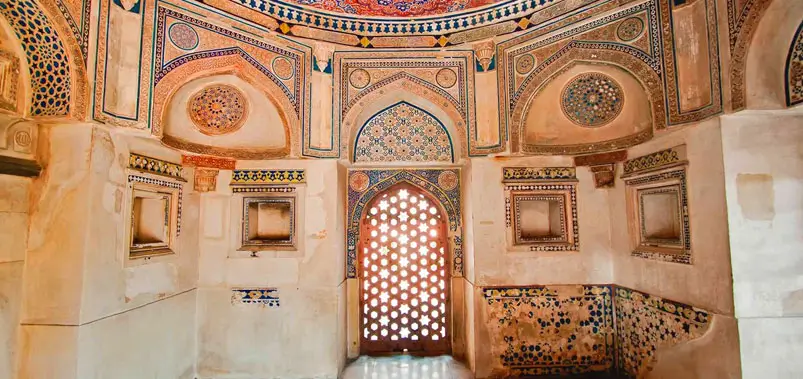
One of the monument's greatest highlights is its extraordinary Pietra Dura (locally called Parchin Kari) decoration.
Tiny pieces of semi-precious stones are carefully inserted into polished marble to create intricate floral and geometric patterns.
Common stones include:
The craftsmanship is remarkably delicate, and many of the same techniques continue to be used today by Agra's marble artisans.
Visitors planning to purchase marble handicrafts often gain a deeper appreciation for the skill involved after seeing these original 17th century masterpieces.
Compared with the crowded pathways surrounding the Taj Mahal, the Baby Taj provides a much more relaxed photography experience.
Some of the best photography opportunities include:
Because visitor numbers are relatively low, photographers often have plenty of time to experiment with different compositions without feeling rushed.
The Baby Taj is generally open:
Sunrise to Sunset
Daily throughout the week.
Most visitors spend:
1–2 hours
exploring the monument and gardens comfortably.
Indian and foreign visitor ticket prices follow the rates set by the Archaeological Survey of India (ASI) and are subject to revision. It is advisable to check the latest prices before your visit or purchase tickets through the official ASI ticketing system.
One of the most overlooked features of the Baby Taj is its beautifully designed Charbagh (Four Part Garden), a classic element of Persian and Mughal landscape architecture.
The gardens are divided into four symmetrical sections by stone pathways and narrow water channels, representing the Islamic concept of paradise. Cypress trees, flowering plants, green lawns, and carefully planned walkways surround the mausoleum, creating a peaceful environment that contrasts sharply with the busy streets of Agra.
Unlike the gardens at the Taj Mahal, which often become crowded with visitors, the Baby Taj's gardens remain relatively quiet throughout the day. This peaceful setting allows visitors to sit on shaded benches, admire the architecture from different angles, and enjoy a slower pace of sightseeing.
For travellers who appreciate landscape design or simply want a break from crowded tourist attractions, the gardens alone make the monument worth visiting.
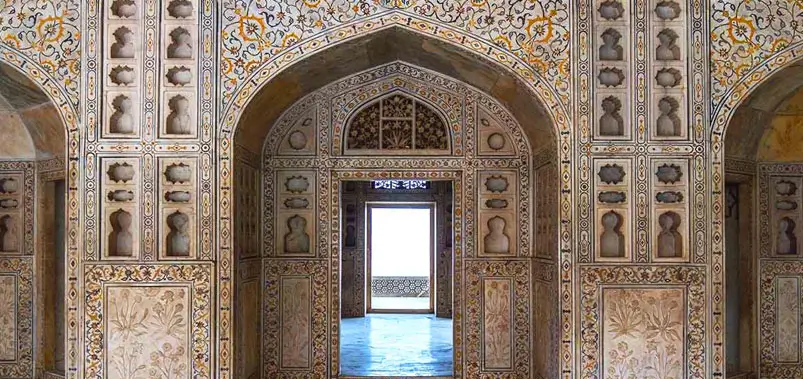
While the exterior of the monument immediately captures attention with its delicate marble work, the interior reveals another level of Mughal craftsmanship.
The central chamber houses the symbolic cenotaphs of Mirza Ghiyas Beg (Itimad-ud-Daulah) and his wife, while the actual graves lie in the lower crypt according to Mughal tradition.
The interior walls and ceilings are decorated with remarkably well preserved artwork featuring:
Unlike many Mughal monuments where decoration is concentrated on the exterior, the Baby Taj offers equally impressive artistic details inside the building.
Visitors should take their time looking closely at the painted ceilings and marble surfaces, as many of the finest details are easy to overlook at first glance.
Among the monument's greatest artistic achievements are its exquisite Jali (lattice) screens.
Carved from single slabs of white marble, these perforated screens allow natural light to filter into the interior while creating beautiful patterns of light and shadow throughout the day.
Each screen features a unique geometric or floral design, demonstrating the extraordinary precision achieved by Mughal craftsmen more than 400 years ago.
These marble screens later inspired the elegant lattice work found in parts of the Taj Mahal.
For photographers, the interplay of sunlight passing through the Jalis creates some of the monument's most beautiful compositions.
Although the monument is open from sunrise to sunset, choosing the right time greatly enhances the experience.
Morning offers:
The marble appears fresh and luminous, making this one of the best times for architectural photography.
As the afternoon light softens, the monument takes on warm golden tones.
This is also the ideal time to combine your visit with nearby attractions such as Mehtab Bagh, where you can watch the sunset over the Taj Mahal.
This is the most comfortable season for sightseeing, with pleasant daytime temperatures ranging between 15°C and 28°C. Early mornings can be cool, so carrying a light jacket is advisable.
Daytime temperatures frequently exceed 40°C, making early morning visits strongly recommended.
.webp)
One of the advantages of visiting the Baby Taj is its convenient location.
Several major attractions are only a short drive away.
Distance: Approximately 2 km
A beautifully restored Mughal garden offering spectacular panoramic views of the Taj Mahal across the Yamuna River.
Distance: Approximately 5 km
Most visitors combine the Baby Taj with the Taj Mahal on the same day, allowing them to compare two remarkable examples of Mughal architecture.
Distance: Approximately 4 km
The magnificent UNESCO World Heritage fortress that served as the residence of the Mughal emperors.
Perfect for:
The monument is easily accessible from anywhere in Agra.
Most local sightseeing tours covering Agra's major monuments include the Baby Taj as part of the itinerary.
|
Feature |
Baby Taj |
Taj Mahal |
|---|---|---|
|
Construction Period |
1622–1628 |
1632–1653 |
|
Built By |
Nur Jahan |
Shah Jahan |
|
Dedicated To |
Mirza Ghiyas Beg (Itimad-ud-Daulah) |
Mumtaz Mahal |
|
Main Material |
White Marble |
White Marble |
|
Visitor Crowds |
Low |
Very High |
|
Photography |
Relaxed |
Often Busy |
|
Average Visit Time |
1–2 Hours |
2–3 Hours |
|
Historical Importance |
Architectural precursor |
UNESCO World Heritage Site & Wonder of the World |
Rather than competing with the Taj Mahal, the Baby Taj complements it by helping visitors understand the evolution of Mughal architecture.
The Baby Taj is one of Agra's most rewarding monuments for photography.
To capture its beauty:
Because the site is generally quieter than the Taj Mahal, you'll have more freedom to compose your photographs without large crowds.
8:00 AM – Arrive at the Baby Taj
8:15 AM – 10:00 AM – Explore the monument, gardens, and interiors
10:15 AM – Visit a nearby marble inlay workshop to learn about the traditional Parchin Kari technique still practised by Agra's artisans.
11:30 AM – Continue to Agra Fort
1:30 PM – Lunch at a local restaurant
4:30 PM – Visit Mehtab Bagh for panoramic views of the Taj Mahal at sunset
This itinerary combines some of Agra's finest historical attractions while avoiding the busiest tourist hours.

We promise you a holiday where everything is taken care of from the moment you land. Trusted drivers waiting for you, handpicked hotels that fit your style, personalized itineraries designed just for your family, and a dedicated team on call 24/7. All you need to do is relax, explore, and create unforgettable memories, while we take care of every detail behind the scenes.
The Baby Taj combines remarkable Mughal history, pioneering marble craftsmanship, tranquil gardens, and fewer crowds, offering a unique perspective on the artistic traditions that later reached their peak in the Taj Mahal.
The distance is approximately 5 kilometres, and the journey typically takes 15–20 minutes by road.
Yes. Photography is permitted in most areas, making the Baby Taj a favourite destination for architecture and travel photographers.
Yes. Both attractions are only a short drive apart and are commonly included in the same sightseeing itinerary.
Yes. The monument generally receives far fewer visitors, allowing for a more relaxed and peaceful visit.
Early morning and late afternoon are ideal for pleasant weather, softer light, and excellent photography conditions.
Absolutely. It offers a quieter experience and provides valuable insight into the architectural evolution that culminated in the Taj Mahal.
Most visitors spend 1 to 2 hours exploring the monument, gardens, and interiors at a comfortable pace.
The mausoleum was commissioned by Nur Jahan, the influential wife of Emperor Jahangir, in memory of her father Mirza Ghiyas Beg, who held the title Itimad-ud-Daulah.
It earned the nickname because of its white marble construction, intricate stone inlay, symmetrical gardens, and architectural similarities to the Taj Mahal. It is also considered the monument that inspired many elements later used in the Taj Mahal.