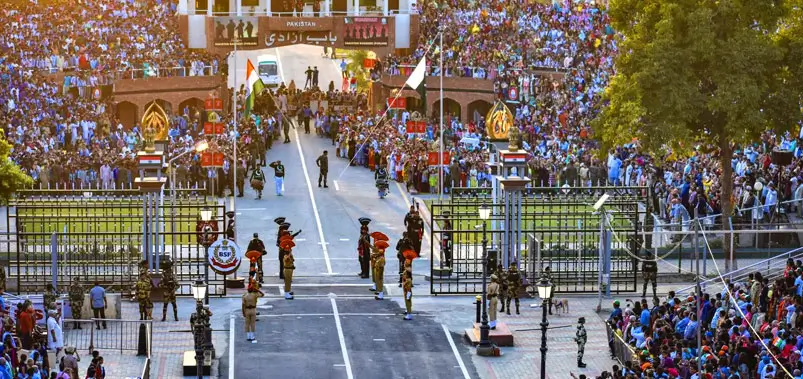
The Wagah Border ceremony is one of the most unusual additions an international traveler can make to an Amritsar itinerary. Held at the India-Pakistan border near Attari, the daily military ceremony combines precise drill movements, patriotic energy, synchronized border procedures, music, cheering crowds, and the formal lowering of the national flags before the border gates close for the evening.
For travelers from the United States, the experience can be difficult to picture before arriving. It is not a quiet military parade, and it is not simply a border checkpoint where visitors watch guards lower two flags. The atmosphere often resembles a packed sporting event, with large crowds arriving well before the ceremony, patriotic songs playing through loudspeakers, spectators waving flags, and India's Border Security Force personnel conducting highly theatrical drill movements.
The Indian side of the crossing is at Attari, approximately 30 kilometers from central Amritsar, while Wagah lies on the Pakistani side. The event is widely called the Wagah Border Ceremony, although travelers may also encounter the names Attari Wagah Border Ceremony, Beating Retreat Ceremony, and Attari Border Ceremony.
There is generally no standard admission fee for ordinary spectators. That makes the ceremony accessible, but free admission should not be mistaken for a casual walk-in attraction. Security is strict, crowds can be significant, seating is subject to availability, and ceremony times change with daylight and season.
For a comfortable visit, the most important decisions are surprisingly simple: confirm the ceremony timing on the day, leave Amritsar early, carry almost nothing, arrange dependable return transportation, and never build the schedule around arriving at the border just before the published starting time.
.webp)
The Wagah Border ceremony timing is linked to sunset, which means travelers should not rely on one fixed time throughout the year.
The retreat ceremony generally takes place in the late afternoon or early evening. During warmer months with longer daylight, it commonly begins later, often around 5:00 PM to 5:30 PM. During winter, when sunset occurs earlier, the ceremony may begin around 4:00 PM to 4:30 PM.
These times should be treated as practical seasonal ranges rather than a guaranteed daily schedule.
Security arrangements, official requirements, special events, weather, border conditions, and seasonal daylight can affect visitor access or timing. Anyone traveling specifically for the ceremony should have the hotel, driver, guide, or tour operator verify the current schedule before departure.
More important than the ceremony's official start time is the recommended Wagah Border arrival time.
Arriving 10 or 15 minutes before the event is a poor strategy.
On a normal day, international travelers should generally aim to reach the border area at least 60 to 90 minutes before the expected ceremony. During weekends, Indian public holidays, school vacations, major festivals, or periods of exceptionally high domestic tourism, arriving 90 minutes to two hours early can be sensible.
The reason is straightforward. Your vehicle does not necessarily deliver you directly to a reserved seat. There may be walking, security screening, queues, crowd management, and time required to reach the spectator area.
For a ceremony expected around 5:00 PM, a premium private itinerary might leave central Amritsar around 2:30 PM to 3:00 PM, depending on the day's traffic and anticipated crowd level. For an earlier winter ceremony, departure should move forward accordingly.
The drive from central Amritsar to Attari is normally around 45 minutes to one hour, but traffic can substantially increase the return time after the ceremony because thousands of spectators may leave at approximately the same moment.
This is why a private car from Amritsar to Wagah Border is usually the most comfortable arrangement for foreign travelers.
The ceremony itself is relatively short. The central retreat proceedings commonly take approximately 30 to 45 minutes, although the overall spectator experience is longer because of the atmosphere before the formal drill begins.
Before the principal military sequence, crowds gather, music is played, patriotic participation builds, and spectators settle into the viewing stands. Arriving early is therefore not necessarily wasted time. The pre-ceremony atmosphere forms part of the experience.
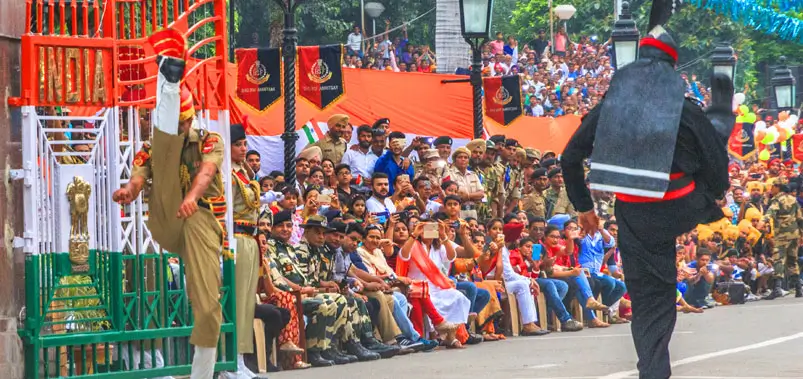
When the formal proceedings begin, personnel from India's Border Security Force and Pakistan Rangers conduct coordinated movements on their respective sides. The famously high marching steps, sharp gestures, gate opening, flag lowering procedure, and eventual closing of the gates create the visual drama associated with the ceremony.
Despite the competitive theatricality, the lowering of the flags is carefully coordinated.
Travelers interested in photography should be ready before the central sequence starts. The most recognizable moments happen quickly, and the combination of distance, crowds, movement, and late afternoon light can make photography more challenging than expected.
A phone with a good zoom or a moderate telephoto camera lens is more useful than bringing a large collection of equipment. Security rules should always be checked before carrying professional camera gear.
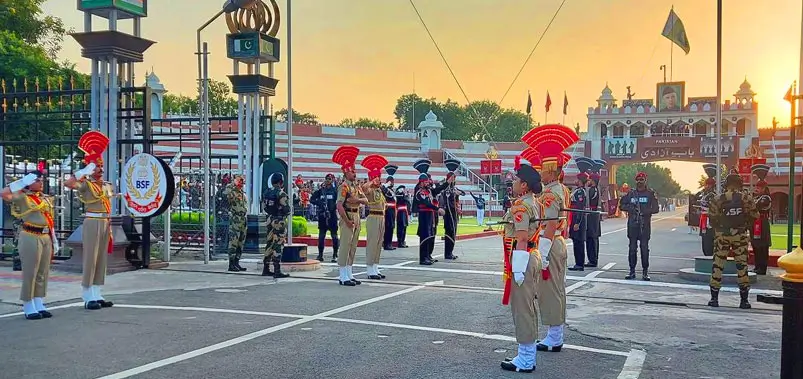
One of the most useful facts for first time visitors is that Wagah Border entry is generally free for ordinary spectators.
Travelers should be cautious if someone outside the official system attempts to sell a basic “entry ticket” without clearly explaining what service is actually being provided.
You may legitimately pay for transportation, a private guide, parking related arrangements, packaged excursions, or other travel services. That is different from paying an ordinary entrance fee for the public ceremony.
Free entry also means that good seating is not automatically guaranteed.
The spectator area on the Indian side has substantial capacity, but popular days can still become extremely busy. Seating procedures and access categories may change, and foreign travelers should not assume that a passport automatically guarantees a premium front row seat.
Carry your original passport if you are an international visitor.
A passport can be important for identification and may be requested during security procedures or when using access arrangements applicable to foreign visitors. Your local guide or hotel should confirm current requirements before you leave.
Security at an international land border is understandably serious.
The easiest rule for travelers is to carry as little as possible.
A passport, phone, small wallet, essential medication, and perhaps a compact water bottle if currently permitted are far easier to manage than a backpack full of sightseeing equipment.
Large bags and backpacks can create problems at security checkpoints. Restrictions can change, so avoid arriving with luggage, shopping bags, large handbags, unnecessary electronics, drones, tripods, or equipment that might be questioned.
Drones should never be treated as ordinary travel equipment near the India Pakistan border.
This is a sensitive international border and security zone. Attempting unauthorized drone photography is inappropriate and can create serious legal and security problems.
Professional photography equipment can also receive additional scrutiny. Travelers carrying substantial camera equipment should ask their tour operator about current rules beforehand.
Ordinary mobile phone photography is widely associated with the spectator experience, but visitors should follow all instructions from security personnel. If photography is restricted in a particular location or at a particular moment, comply immediately.
Comfort also matters.
The spectator stands can involve steps, hard seating, crowd density, and extended periods outdoors. During warmer months, late afternoon heat can be significant. During winter, the temperature may drop quickly as the sun goes down.
Wear comfortable walking shoes.
For summer visits, breathable clothing, sunscreen, sunglasses, and sun protection are useful. For winter visits, carry a light jacket or warmer layer, particularly if you will be outside after sunset.
Clothing should be practical and respectful. There is no need for formal attire. Travelers visiting the Golden Temple and Wagah Border on the same day should remember that the Golden Temple has its own religious etiquette, including head covering and removing shoes before entering the sacred complex.
Food and beverages are available around the broader visitor area, but a premium traveler may prefer to eat before departure or after returning to Amritsar rather than relying on snacks at the border.
Restroom availability should also be considered, especially for older travelers and families. Use facilities before settling into the spectator area whenever possible because leaving and attempting to regain a position can be inconvenient when crowds increase.
The distance from Amritsar to Wagah Border is roughly 30 kilometers, depending on your starting point in the city. The road journey typically takes around 45 minutes to one hour in ordinary conditions.
Travelers should never calculate their departure time using the distance alone.
Traffic toward Attari increases as ceremony time approaches, and security or crowd control measures can slow the final portion of the journey. The return can be even busier because a large portion of the audience leaves simultaneously after the flags have been lowered.
For luxury international travelers, a private chauffeured car to Wagah Border is the most convenient option.
A pre-arranged driver can collect you from the hotel, wait during the ceremony, and return you to Amritsar afterward. This removes the need to negotiate transportation in a crowded area after dark.
Prices vary according to vehicle class, duration, hotel, operator, waiting time, and whether a guide accompanies the excursion.
For a simple private round trip car from Amritsar, travelers might encounter local prices beginning around INR 1,500 to INR 3,000 for standard vehicle categories. Larger or more premium vehicles, longer waiting periods, guide services, hotel arranged transportation, and higher end tour operations can raise the price to approximately INR 3,500 to INR 7,500 or more.
Luxury transportation can cost above these ranges.
For American travelers, this is not the part of an India trip where saving $20 or $30 should determine the decision. A reliable driver, clean air conditioned vehicle, proper waiting arrangement, and confirmed pickup point after the ceremony provide substantially more value than finding the lowest possible taxi fare.
Shared excursions and local transport are available for budget conscious visitors, but they offer less flexibility.
A private Wagah Border tour from Amritsar is particularly useful when the ceremony is combined with other sightseeing. A driver and guide can coordinate hotel pickup, a suitable lunch schedule, border departure, and evening return without forcing the traveler to follow a group timetable.
Travelers staying in high end Amritsar hotels can also ask the concierge to arrange transportation. Hotel cars often cost more than local taxis, but guests may value the accountability and convenience.
If booking independently, confirm whether the quoted amount includes round trip transportation, waiting time, parking, taxes, and any driver allowance.
Never assume that a one way fare includes the driver waiting through the ceremony.
The pickup arrangement after the event should be discussed before leaving the vehicle. Mobile networks can become busy around large gatherings, and trying to locate an unfamiliar driver among hundreds of vehicles is not an ideal end to the evening.
Ask the driver to establish a specific meeting point.
Take a photo of the vehicle and license plate if useful. Keep the driver's phone number accessible. If traveling with a private guide, the guide can manage this coordination.
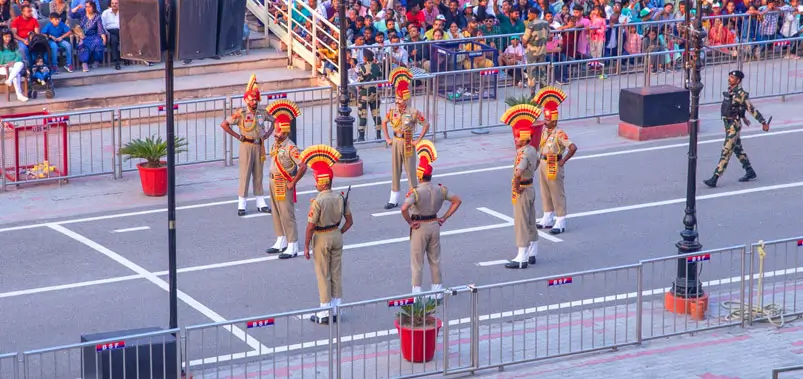
For most first time visitors, Golden Temple and Wagah Border form the core of an Amritsar stay. Both can be visited on the same day, but the schedule should not be compressed unnecessarily.
The Golden Temple deserves time.
Early morning is one of the finest periods to visit because the complex is active yet often feels more contemplative than during peak daytime hours. The illuminated temple reflected in the surrounding sacred pool creates one of India's most memorable religious settings.
A private itinerary might begin with the Golden Temple in the morning, followed by breakfast or lunch, a short hotel break, and then the afternoon drive to Attari.
Travelers interested in history can also include Jallianwala Bagh, located close to the Golden Temple. The site commemorates the massacre that took place under British colonial rule and provides important historical context for understanding modern India.
The Partition Museum is another significant Amritsar attraction for travelers interested in the human history surrounding the partition of British India.
Attempting to visit all of these places, shop extensively, eat a long lunch, and then leave late for the border is where itineraries begin to fail.
The ceremony cannot simply be moved because sightseeing ran behind schedule.
A well-managed Amritsar private tour works backward from the confirmed border timing. The afternoon departure is protected, and earlier sightseeing is adjusted accordingly.
For travelers staying two nights, an even better approach may be to separate the activities. The Golden Temple can be visited during a quieter early morning and perhaps again after dark, while the Wagah excursion occupies a separate afternoon.
Seeing the Golden Temple illuminated at night is particularly worthwhile.
Travelers combining Amritsar with a Golden Triangle Tour can usually add the city before or after Delhi. Delhi and Amritsar are connected by flights and trains, including fast rail options on suitable schedules.
For luxury travelers, the choice between air and rail depends on the overall itinerary. A well timed premium train can provide an interesting Indian travel experience without the airport process, while a flight may be more convenient when connecting with another sector.
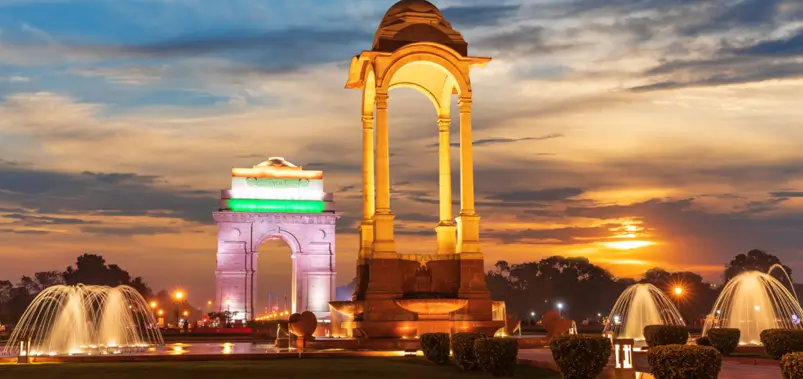
A Golden Triangle with Amritsar tour creates a strong cultural progression. Delhi introduces Mughal, colonial, and modern India. Agra provides the Taj Mahal and Mughal architecture. Jaipur brings Rajput palaces and forts. Amritsar then adds Sikh heritage, the Golden Temple, Partition history, and the India Pakistan border ceremony.
Three nights in Amritsar can provide a relaxed stay, although two nights are sufficient for many travelers if arrival and departure times are favorable.
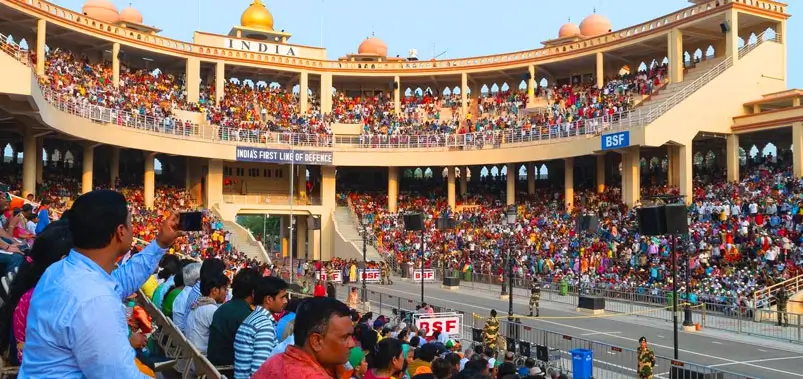
International visitors occasionally arrive expecting a solemn border ritual and are surprised by the intensity of the crowd.
Expect noise.
Expect cheering.
Expect patriotic music.
Expect enthusiastic audience participation.
Expect a theatrical element to the drill.
The Indian and Pakistani spectator stands face their respective ceremony areas, creating a highly unusual environment in which two national audiences watch parallel military proceedings separated by an international boundary.
For some travelers, this is fascinating. Others may find the nationalism intense. The best approach is to observe it within its historical and cultural context rather than treating it purely as entertainment.
India and Pakistan share a complicated history shaped by partition, wars, political tensions, family separation, cultural connections, and a heavily controlled border. The ceremony reflects elements of that relationship while also functioning as a major visitor attraction.
Foreign travelers should remain respectful.
There is no need to participate in political shouting or provocative behavior. Do not make jokes about border security, attempt to cross restricted barriers, photograph security installations against instructions, or argue with personnel regarding access.
Follow directions immediately.
Travelers with mobility limitations should discuss the visit with their operator beforehand. Walking distances, stairs, security queues, and crowded seating can make the experience more physically demanding than the ceremony's short duration suggests.
Older guests may still enjoy the event, but a private car, earlier arrival, careful seating strategy, and guide assistance become more valuable.
Families with children should also prepare for loud music, crowds, and waiting. Hearing protection may be worth considering for very young children or anyone sensitive to loud environments.
Travelers prone to heat exhaustion should be particularly cautious during hot weather. Hydrate before arrival, avoid excessive alcohol earlier in the day, and protect yourself from direct sun.
The ceremony is generally regarded as suitable for international tourists, and large numbers of visitors attend. Normal travel awareness still applies. Keep valuables secure in crowded areas and carry only what you actually need.
The ceremony works best when it is treated as a scheduled event rather than a casual sightseeing stop.
Your hotel or tour operator should reconfirm the Attari Wagah Border ceremony timing shortly before the visit. Your driver should leave Amritsar with a generous traffic buffer. Your passport should be with you. Unnecessary bags should remain at the hotel. Your return meeting point should be established before entering the spectator area.
Those five details eliminate many of the most common frustrations.
Travelers seeking a higher level of comfort should use a private air conditioned vehicle and, where useful, an experienced local guide. The guide can assist with timing, security procedures, orientation, historical context, and locating the driver after the ceremony.
There is no reason to pay inflated prices merely because something is labeled “VIP.” Be cautious about unofficial claims of guaranteed VIP access or special seating. Access rules can change, and legitimate special arrangements depend on current official procedures.
A reputable India private tour operator should explain what can genuinely be arranged instead of promising access that is outside its control.
For guests traveling with Golden Triangle Tours, Amritsar can be incorporated as a private extension to Delhi, Agra, and Jaipur. The practical advantage is that the border visit, hotel, transportation, Amritsar sightseeing, and onward connection can be coordinated as one itinerary rather than booked as unrelated pieces.
A well-paced Amritsar stay can include the Golden Temple at a favorable time, Jallianwala Bagh, the Partition Museum, authentic Punjabi cuisine, sufficient hotel rest, and the Wagah Border evening ceremony without turning the day into a race.
The ceremony itself may occupy less than an hour, but travelers should realistically allocate four to five hours for the complete excursion from central Amritsar when road travel, early arrival, security, waiting, the ceremony, and return traffic are included.
That is the practical number to remember.
Do not schedule a critical flight or train immediately after the ceremony. Border traffic and road conditions are too variable to make a tight connection worthwhile.
Instead, return to Amritsar, have dinner, and keep onward travel for a comfortable time.
The Wagah Border Ceremony from Amritsar is worth attending precisely because it is unlike the palaces, forts, temples, and archaeological sites travelers see elsewhere in India. With realistic timing and sensible logistics, it can become one of the most distinctive evenings of a private North India journey.
We promise you a holiday where everything is taken care of from the moment you land. Trusted drivers waiting for you, handpicked hotels that fit your style, personalized itineraries designed just for your family, and a dedicated team on call 24/7. All you need to do is relax, explore, and create unforgettable memories, while we take care of every detail behind the scenes.
Yes, particularly for travelers interested in modern Indian history, India-Pakistan relations, military traditions, and contemporary culture. A private Wagah Border tour from Amritsar with comfortable transportation and sufficient arrival time makes the experience much easier for international visitors.
Yes. Golden Temple and Wagah Border in one day is a common itinerary. Visit the Golden Temple in the morning, allow time for lunch and rest, then leave for Attari well before the confirmed ceremony time.
Visitors commonly use phones and cameras in permitted spectator areas, but security instructions always take priority. Avoid drones and do not photograph restricted security areas or personnel contrary to official directions.
It is better not to. Border security restrictions can be strict, and large bags can cause delays or be prohibited from certain areas. Carry only essential personal items and confirm current restrictions before departure.
Yes. Foreign tourists can attend the Attari-Wagah ceremony. International travelers should carry their original passport and follow the current security and access instructions.
Rates vary considerably. A standard private round-trip vehicle may start around INR 1,500–3,000, while larger vehicles, premium cars, guide services, hotel arrangements, and higher service levels may bring the cost to approximately INR 3,500–7,500 or more.
The border is roughly 30 kilometers from central Amritsar. Driving usually takes approximately 45 minutes to one hour, although ceremony traffic can increase travel time substantially.
Ordinary spectator entry is generally free. Travelers may separately pay for private transportation, guides, parking-related services, or organized excursions.
Arrive at least 60 to 90 minutes before the ceremony on an ordinary day. On weekends, public holidays, festival periods, and exceptionally busy dates, arriving up to two hours early may be worthwhile.
The Wagah Border Ceremony timing changes with season and sunset. A practical expectation is approximately 4:00–4:30 PM during parts of winter and around 5:00–5:30 PM during warmer months. Always reconfirm the current day's schedule locally before leaving Amritsar.