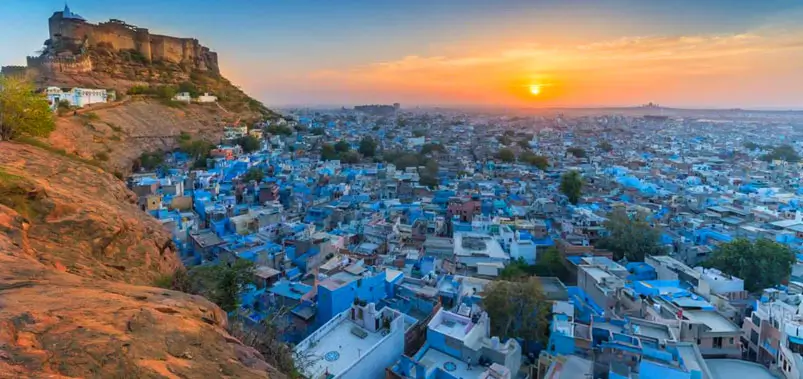
Jodhpur is one of the easiest cities in Rajasthan to recognize from a photograph. Below the massive walls of Mehrangarh Fort, tightly packed neighborhoods spread across the old city in shades of powder blue, indigo, cobalt, turquoise, and faded sky blue. From above, those houses create the famous image that gave Jodhpur its international nickname: the Blue City of India.
For travelers arriving from the United States, the visual impression can seem almost too perfect. It is easy to assume that the entire city was painted blue for tourism or that every house follows a single centuries old rule. The reality is more interesting and more complicated. The blue color developed gradually within specific old city neighborhoods, and several explanations are tied to local social history, climate, lime based paint, community identity, and practical maintenance traditions. There is no single universally accepted explanation that accounts for every blue wall in Jodhpur.
That uncertainty is part of the city's appeal.
The blue houses are not a theme park backdrop. They belong to lived in neighborhoods below Mehrangarh Fort, where families, temples, small shops, workshops, guesthouses, courtyards, markets, scooters, cattle, and daily street life all exist within the same historic urban fabric. Some houses are intensely blue, some are pale, some have been repainted in other colors, and some have lost the blue coating almost entirely.
Travelers expecting an uninterrupted sea of identical blue buildings can therefore be disappointed if they only drive through the newer parts of Jodhpur. The strongest Blue City Jodhpur experience is found on foot, particularly in older neighborhoods around the base of Mehrangarh Fort, where narrow lanes reveal the color at eye level.
The view from Mehrangarh is the best introduction, but the streets below provide the real understanding.
The most repeated explanation is that blue houses were historically associated with Brahmin families living in the old city. According to this interpretation, the color helped identify homes belonging to members of the priestly caste. Over time, other residents also adopted the color, and blue gradually became a broader architectural characteristic rather than a strict social marker.
This explanation appears frequently in local histories and guide commentary, but it should not be treated as the only reason Jodhpur became blue.
Another practical explanation concerns traditional lime based coatings.
Historic houses in Rajasthan were commonly maintained using lime plaster and limewash. Indigo or blue pigment could be added to the mixture, producing the color visible across many old city walls. Lime coatings were practical because they helped protect masonry and could be reapplied relatively easily.
The blue pigment may also have been associated with insect resistance, particularly as a traditional belief that certain additives helped discourage termites or mosquitoes. Travelers will often hear this explanation from local guides. The exact scientific effectiveness of historic formulas is difficult to generalize because mixtures varied by household and period, but the belief itself became part of the local narrative surrounding the color.
Climate is another part of the story.
Jodhpur sits on the edge of the Thar Desert, and the city can become intensely hot. Light colored exterior surfaces reflect more sunlight than dark masonry. Pale blue and limewashed walls may therefore contribute to a visually and physically cooler environment, particularly when combined with thick stone construction, shaded courtyards, narrow lanes, and traditional ventilation.
It would be inaccurate, however, to suggest that blue paint alone keeps an old Jodhpur house cool.
Traditional urban design does much of the work.
The old city's narrow streets create shade. Buildings sit close together. Thick walls slow heat transfer. Courtyards manage airflow. Small openings reduce direct solar gain. The blue limewash is part of a larger architectural response to hot conditions rather than a magic cooling technology.
Religious and symbolic associations also appear in discussions of the color. Blue has strong visual significance in Indian culture and is associated with deities including Krishna. That cultural familiarity may have made the color attractive, but it is difficult to prove that one religious explanation caused the entire neighborhood pattern.
The strongest answer to why Jodhpur is blue is therefore not a single sentence.
The color appears to have grown from a combination of community identity, traditional limewash, practical maintenance, climatic logic, local aesthetics, and repeated household custom. Once enough buildings adopted blue shades, the color itself became part of the identity of old Jodhpur.
Today, that identity has international value.
Images of blue houses below Mehrangarh appear in travel magazines, luxury tour brochures, hotel photography, social media, and destination campaigns around the world. Yet the neighborhoods remain residential, which is why visitors should approach them respectfully rather than treating private doorways and courtyards as open photographic sets.
The most important practical point for first time visitors is that not all of Jodhpur is blue.
The modern city extends well beyond the old neighborhoods beneath Mehrangarh Fort. Wide roads, commercial districts, residential developments, hotels, and newer buildings may look very different from the iconic images travelers have seen online.
The strongest concentration of blue houses lies within the old city around Mehrangarh Fort, particularly in historic neighborhoods on and below the hill.
A guided walk is the best way to find them.
Trying to navigate solely with a map can be frustrating because the lanes twist, change width, climb, descend, and occasionally appear to end inside residential areas. Street names and map pins do not always capture the practical walking route.
A knowledgeable local guide can lead travelers through blue neighborhoods without unnecessarily intruding into private areas.
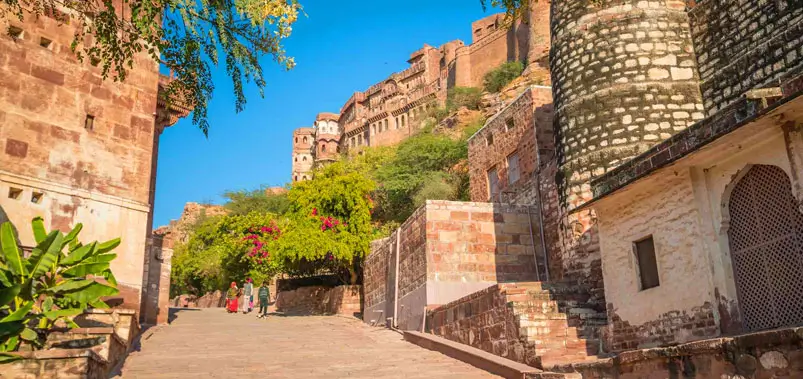
Areas around Navchokiya are particularly associated with the classic blue house landscape. This old residential quarter sits beneath Mehrangarh and contains narrow streets, traditional homes, small shrines, painted facades, and excellent views toward the fort.
This is where the Blue City begins to make sense at ground level.
One lane may contain an intense cobalt blue wall beside a pale turquoise doorway. Around the next corner, a faded blue courtyard may sit opposite an unpainted sandstone building. Scooters are parked beneath carved balconies. Electrical wires cross above old facades. Families sit outside houses while temple bells sound nearby.
The visual character is far more textured than the simplified aerial photograph.
Travelers interested in photography should resist the urge to rush.
Light shifts constantly in the lanes. Direct sunlight can create harsh contrast, while shaded alleys produce softer colors. Early morning works particularly well because temperatures are lower and streets may be quieter.
Late afternoon can also be beautiful, particularly when the fort begins catching warmer light.
Midday is usually less comfortable.
Jodhpur's heat can become severe, and narrow lanes do not always provide continuous shade. A Blue City walking tour in Jodhpur is far more pleasant when scheduled early or late rather than around the hottest part of the day.
Comfortable walking shoes are essential.
Old city paving can be uneven. Steps appear unexpectedly. Some lanes are steep. Vehicles and scooters pass through spaces that may seem pedestrian only to foreign visitors.
Travelers with limited mobility should tell the guide before starting.
The goal is not to follow one rigid route. A shorter route through accessible streets can still provide an excellent experience.
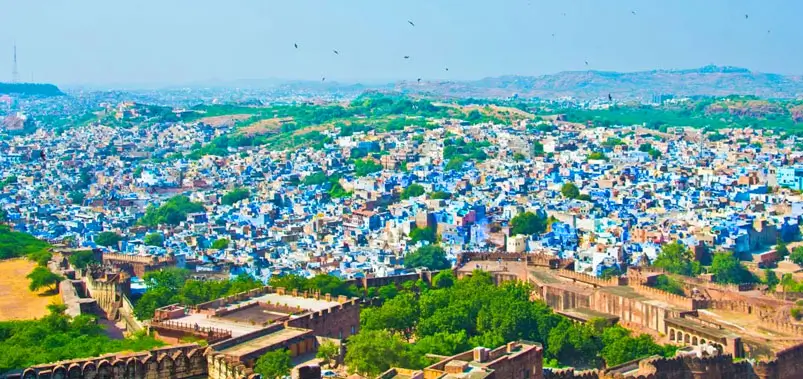
For the widest perspective, nothing replaces Mehrangarh Fort.
The fort rises high above old Jodhpur and provides several elevated views across the city. From the ramparts and palace windows, visitors can see how the historic neighborhoods cluster beneath the fortress.
This is where the nickname Blue City becomes visually obvious.
From street level, individual blue houses can feel scattered. From above, the concentration becomes clearer.
Morning light often provides the best balance between visibility and physical comfort. The fort opens at 9:00 AM, and arriving close to opening time allows travelers to tour the museum before the day becomes hotter.
Photographers should pay attention to the direction of the sun.
The blue neighborhoods can appear softer or more intense depending on light, haze, and season. Winter mornings may occasionally bring atmospheric haze, while dry weather afternoons can produce sharper long distance visibility.
The view is not uniformly blue in every direction.
This is important for realistic expectations.
The strongest traditional blue areas sit in particular parts of the old city, while newer districts include many other colors and building styles. Wide angle photographs often emphasize the blue concentration and make the effect appear more uniform than it feels in person.
That does not make the view less impressive.
It makes it more real.
Mehrangarh also provides the architectural context needed to understand why the city developed where it did. The fort was the center of political and military power, while settlement expanded below the hill. Houses, markets, temples, and workshops grew around the royal stronghold over centuries.
For a premium itinerary, the strongest sequence is to visit Mehrangarh Fort in the morning, look down over the blue neighborhoods, then walk selected old city lanes later in the day.
Seeing the city first from above and then from inside the streets creates a much stronger sense of place.
Jodhpur is one of Rajasthan's most rewarding cities for photography, but the Blue City neighborhoods are residential communities.
That distinction should guide every camera decision.
Photographing a blue wall, doorway, lane, rooftop, fort view, or architectural detail is straightforward. Photographing residents inside their homes, children, private courtyards, religious rituals, or people going about personal activities requires more sensitivity.
Ask before taking close portraits.
If someone clearly does not want to be photographed, move on.
Do not stand in a doorway simply because the paint color is beautiful.
Do not enter courtyards because another traveler's photograph suggested the space was public.
Some photographers arrange local portrait sessions with residents, craftspeople, or guides. That can be done respectfully when permission and expectations are clear.
A wide angle phone lens works extremely well in the narrow streets. Serious photographers may prefer a compact wide to normal zoom rather than a large telephoto setup.
Large tripods are often impractical.
The best images frequently come from simple compositions: a blue staircase, carved door, shadow across a wall, bicycle against an indigo facade, or Mehrangarh rising above a narrow lane.
The fort is almost always present in the visual psychology of old Jodhpur.
Even when it is not visible, its position determines the slope and orientation of the surrounding streets.
For travelers who want professional photographs without carrying equipment, a private photographer can be arranged for a short session. Early morning is usually the easiest time because pedestrian and vehicle traffic is lower.
Luxury travelers should also think carefully about clothing.
Neutral or contrasting colors photograph well against blue facades, but the goal should remain respectful rather than turning a living neighborhood into a costume set.
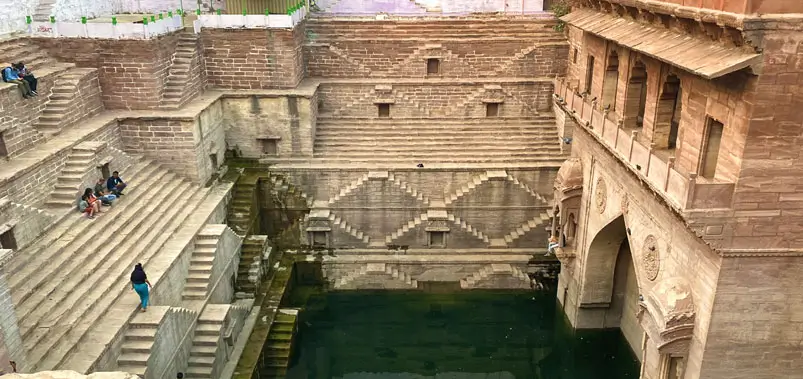
The old blue neighborhoods can be combined naturally with other central Jodhpur landmarks.
Toorji Ka Jhalra, a restored historic stepwell, is one of the easiest additions. The geometric stone structure sits within the old city and provides a dramatic contrast to the painted residential lanes.
Stepwells were practical water structures as well as social spaces, and Rajasthan contains many examples ranging from monumental complexes to neighborhood scale architecture.
The area around Toorji Ka Jhalra also contains cafés, hotels, shops, and restored heritage buildings, making it a useful rest point for travelers who want to sit down after walking.
From there, the route can continue toward Clock Tower and Sardar Market.
The market area is busier and more commercial than the residential blue lanes. Spices, textiles, household goods, snacks, produce, accessories, and general daily commerce create a very different atmosphere.
This is where a private guide becomes particularly helpful for American travelers who want to browse without spending the entire visit negotiating with shopkeepers.
Shopping should remain optional.
A strong guide can recommend reputable sellers when travelers genuinely want textiles, spices, handicrafts, or local products. The guide should not turn the walking tour into a compulsory sequence of commission based stores.
That distinction matters on a premium private tour.
The old city is interesting enough without manufactured shopping stops.
A practical route might begin in the blue neighborhoods beneath Mehrangarh, descend gradually toward Toorji Ka Jhalra, continue through selected heritage streets, and finish around Clock Tower.
This allows most of the walk to trend downhill rather than requiring prolonged climbing.
For travelers staying in the old city, the hotel may be within walking distance at the end.
Guests staying at Umaid Bhawan Palace or another property outside the historic center should arrange a private vehicle pickup at a clearly defined point rather than expecting the driver to enter every narrow lane.
For most visitors, two to three hours is enough for a meaningful guided Blue City walk.
Serious photographers may want longer.
Travelers with only one full day in Jodhpur can combine Mehrangarh Fort in the morning, Jaswant Thada around midday, a hotel rest, and the old city walk in late afternoon.
That creates a much better rhythm than trying to walk immediately after several hours inside the fort.
During warmer months, the midday break is particularly important.
Jodhpur can become physically exhausting when visitors ignore the heat.
Return to the hotel, have lunch, hydrate, rest, and begin again later.
For luxury travelers, this is where itinerary design matters more than the number of attractions.
A six hour uninterrupted sightseeing block does not automatically produce a better trip.
Jodhpur's old neighborhoods are easiest to appreciate when the traveler is not exhausted.
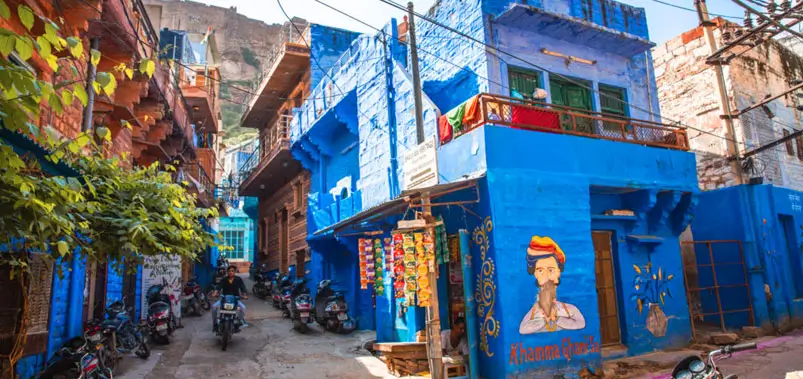
The blue paint receives most of the attention, but the traditional houses of Jodhpur deserve closer observation.
Many old homes were built around courtyards.
Courtyards allow hot air to rise, create shaded interior space, and provide ventilation. Thick masonry walls help moderate indoor temperatures. Small exterior openings reduce direct heat gain. Narrow lanes cast shade across lower walls for much of the day.
The architectural response is particularly logical in a desert edge environment.
Blue limewash adds another visual layer.
Traditional lime coatings have practical benefits because lime is breathable and can help historic masonry release moisture. It can also be renewed repeatedly without creating the same sealed surface as some modern paints.
That repeated maintenance contributes to the variation visible across the city.
Freshly painted houses can appear intensely blue.
Older limewash fades gradually.
Some households select turquoise or blue green shades rather than deep indigo.
Others have replaced blue entirely.
The city is therefore not frozen in one traditional color scheme.
It continues changing.
This is particularly important because tourism has begun influencing the color itself. Some guesthouses, cafés, and hospitality properties deliberately emphasize blue walls because visitors associate the color with Jodhpur.
Tradition and tourism now overlap.
That does not automatically make the blue city inauthentic. Cities continuously adapt their visual identity. It simply means today's Jodhpur reflects both historic custom and modern awareness of what visitors come to see.
.webp)
Travelers familiar with Morocco often compare Jodhpur and Chefchaouen because both cities are known internationally for blue architecture.
The comparison is visually interesting but culturally limited.
Chefchaouen has its own history, religious influences, urban form, and reasons for blue painted streets. Jodhpur developed within the political, social, climatic, and architectural context of Marwar in Rajasthan.
The two should not be treated as interchangeable “blue cities.”
Jodhpur's defining visual relationship is between Mehrangarh Fort and the neighborhoods below it.
The blue houses are part of a larger city dominated by royal history, desert architecture, markets, temples, and sandstone.
Travelers who visit only for blue photographs miss most of what makes Jodhpur compelling.
Hotel choice dramatically changes how travelers experience Jodhpur.
For direct old city immersion, RAAS Jodhpur is one of the strongest luxury options. Its location within the historic city places guests beneath Mehrangarh Fort and close to old streets, stepwells, markets, and restaurants.
The fort becomes part of the hotel's daily visual experience.
For travelers who want to photograph the Blue City early in the morning or walk through the old center without a long vehicle transfer, this location is exceptionally convenient.
The tradeoff is that the surrounding neighborhood is urban and active.
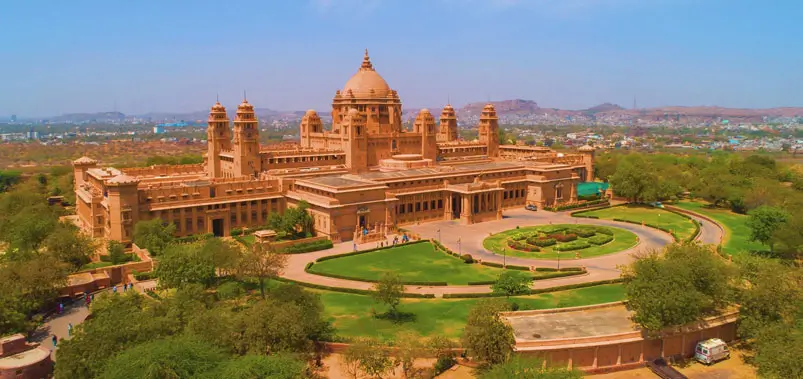
Travelers seeking silence, large lawns, broad resort facilities, and greater separation from the city may prefer Umaid Bhawan Palace.
Umaid Bhawan delivers one of India's great palace hotel experiences but does not provide immediate walkable access to the old blue neighborhoods.
A private car is required.
This is why the best Jodhpur hotel depends on the traveler's priorities.
Choose old city accommodation for immersion.
Choose a palace or resort environment for retreat.
For three nights, either works beautifully when the itinerary is paced correctly.
Jodhpur is one of the strongest extensions to a private Golden Triangle Tour because it introduces a very different version of Rajasthan from Jaipur.
Jaipur is grand, ceremonial, and comparatively open in scale. Amber Fort, City Palace, broad roads, bazaars, and planned urban geometry shape the visitor experience.
Jodhpur feels tighter and more vertical.
Mehrangarh rises directly above dense neighborhoods. The old city folds into narrow streets. Blue houses, stepwells, markets, rooftop views, and sandstone architecture create a stronger sense of medieval urban texture.
Travelers can continue from Jaipur to Jodhpur by private car, rail, or flight depending on the wider itinerary.
For a luxury Rajasthan route, a chauffeur driven private vehicle often makes the most sense because it preserves flexibility and allows the same travel team to continue toward Udaipur.
Two nights in Jodhpur are workable.
Three nights are better.
With three nights, travelers can visit Mehrangarh without rushing, walk the Blue City, enjoy Jaswant Thada, experience the market area, spend time at the hotel, and dine in settings with dramatic fort views.
Guests arranging the journey through Golden Triangle Tours can incorporate Jodhpur after Delhi, Agra, and Jaipur and continue toward Udaipur, creating a deeper Rajasthan itinerary rather than returning immediately to Delhi.
The city should not be sold merely as “the blue place.”
Its strongest appeal comes from the relationship between the blue neighborhoods, Mehrangarh Fort, old city life, Rajput history, and the landscape of Marwar.
The blue walls bring travelers here.
The city around them is what makes them stay.
We promise you a holiday where everything is taken care of from the moment you land. Trusted drivers waiting for you, handpicked hotels that fit your style, personalized itineraries designed just for your family, and a dedicated team on call 24/7. All you need to do is relax, explore, and create unforgettable memories, while we take care of every detail behind the scenes.
Yes. Jodhpur fits naturally after Jaipur in a Golden Triangle and Rajasthan itinerary and can then be combined with Udaipur for a longer private journey through Rajasthan.
RAAS Jodhpur is particularly convenient for old-city immersion and fort views. Umaid Bhawan Palace offers a more secluded palace experience but requires private transportation to reach the blue neighborhoods.
Most travelers should allow approximately two to three hours for a relaxed guided walk including blue residential lanes and nearby old-city landmarks.
Yes. Mehrangarh Fort offers the best panoramic views over Jodhpur's blue neighborhoods, making it an excellent starting point before walking through the streets below.
Early morning or late afternoon is generally best. Temperatures are more comfortable, light is better for photography, and the streets are more enjoyable than during the hottest part of the day.
Yes, but a guide is highly useful. Old-city lanes can be confusing, and a local guide can locate stronger blue neighborhoods while avoiding unnecessary intrusion into private residential areas.
The strongest concentrations are in the old city beneath Mehrangarh Fort, including traditional neighborhoods around Navchokiya and nearby historic lanes.
Light-colored limewash can reflect sunlight, but the cooling effect of traditional Jodhpur homes also comes from thick walls, narrow shaded lanes, courtyards, small openings, and ventilation. Blue color alone does not explain indoor comfort.
One widely repeated tradition associates blue-painted homes with Brahmin families, but the color later spread beyond one social group. Today, blue houses are not limited to Brahmin households.
Jodhpur is called the Blue City because many houses in the old neighborhoods below Mehrangarh Fort are traditionally painted in blue shades. The exact reason involves a mix of social tradition, limewash, climate, household maintenance, and local identity rather than one universally accepted explanation.