Every traveler following the famous Golden Triangle Tour eventually faces the same question: what should be done on the journey between Agra and Jaipur?
Many visitors simply leave Agra after breakfast and arrive in Jaipur several hours later without stopping. While convenient, this approach misses two of North India's most fascinating attractions: Fatehpur Sikri and Chand Baori Stepwell in Abhaneri.
Together, these two destinations transform an ordinary transfer day into one of the most rewarding days of the entire trip. One represents the grandeur of the Mughal Empire, while the other showcases the engineering brilliance of ancient Rajasthan. One was once a thriving imperial capital. The other was a practical water system that evolved into an architectural masterpiece.
What makes this combination particularly appealing is the contrast. Fatehpur Sikri is expansive, royal, and monumental. Chand Baori is geometric, mysterious, and unexpectedly dramatic. Visitors experience two completely different chapters of Indian history within a single day.
Another advantage is convenience. Both sites are located naturally along the Agra–Jaipur route, making them easy to include without major detours. Most private drivers and Golden Triangle tour operators already incorporate these stops because they consistently impress travelers.
Photographers love them because they offer completely different visual opportunities. History enthusiasts appreciate their cultural significance. Families enjoy the variety they add to the journey. Even travelers with limited interest in architecture often leave impressed by the scale and uniqueness of both locations.
The route itself also becomes more interesting. Instead of spending hours simply watching highways pass by, visitors engage with historical sites that help explain India's diverse cultural heritage.
If you have only one day to travel between Agra and Jaipur, including Fatehpur Sikri and Abhaneri is arguably the best decision you can make. The combination delivers history, architecture, photography, storytelling, and cultural insight in a way few travel days can match.
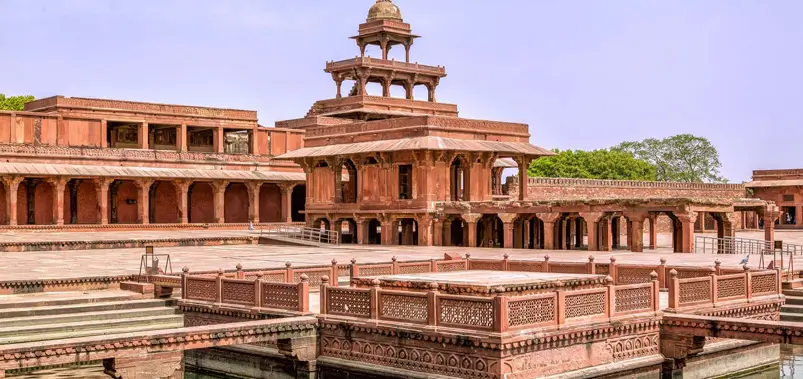
At first glance, Fatehpur Sikri and Chand Baori seem completely unrelated.
One was built by a Mughal emperor in the sixteenth century. The other originated centuries earlier as part of Rajasthan's water management system. Their architectural styles are entirely different, and their historical purposes were not connected.
Yet these differences are exactly what make the pairing so successful.
Travelers begin the day at Fatehpur Sikri, where they encounter massive gateways, royal palaces, ceremonial halls, and religious structures. The site emphasizes political power, imperial ambition, and architectural grandeur.
Later, they arrive at Chand Baori and discover something entirely different. Instead of palaces, they find a deep geometric structure descending dramatically into the earth. Rather than showcasing royal authority, it demonstrates how communities solved practical challenges through extraordinary engineering.
The contrast keeps the day interesting. Visitors never feel as though they are seeing the same type of attraction repeatedly.
Another reason the pairing works well is pacing. Fatehpur Sikri typically requires two to three hours of exploration. Chand Baori generally requires thirty minutes to one hour. The balance allows travelers to enjoy both locations without feeling overwhelmed.
Many visitors also appreciate how the attractions reveal different dimensions of Indian history. Fatehpur Sikri illustrates the sophistication of the Mughal Empire, while Chand Baori reflects the ingenuity of regional communities adapting to challenging environmental conditions.
Together, they provide a broader understanding of the country's historical development.
For travelers interested in learning rather than simply sightseeing, this combination is difficult to surpass.
Approximately forty kilometers west of Agra stands one of the most remarkable historical cities in India.
Fatehpur Sikri was established by Emperor Akbar during the late sixteenth century and briefly served as the capital of the Mughal Empire. Although occupied for only a relatively short period, the city remains one of the best preserved examples of Mughal urban planning and architecture.
Visitors often describe their first impression as surprising. Many expect a collection of monuments similar to those found elsewhere in India. Instead, they discover an entire city filled with palaces, courtyards, administrative buildings, religious structures, and residential areas.
The scale is impressive. Walking through the complex provides insight into how the Mughal court functioned and how imperial authority was expressed through architecture.
The city was strategically important during Akbar's reign and reflected his ambitions as a ruler. Buildings were designed not only for practical purposes but also to communicate power, sophistication, and cultural achievement.
Today, Fatehpur Sikri is recognized as a UNESCO World Heritage Site and attracts visitors from around the world.
Sunrise to Sunset (approximately 6:00 AM to 6:00 PM)
Approximately:
₹610–₹650 per person
(Subject to periodic government revisions.)
2–3 hours
Many travelers regret allocating less time because the complex is larger than expected.
The combination of history, architecture, and atmosphere makes Fatehpur Sikri one of the most rewarding destinations in North India.
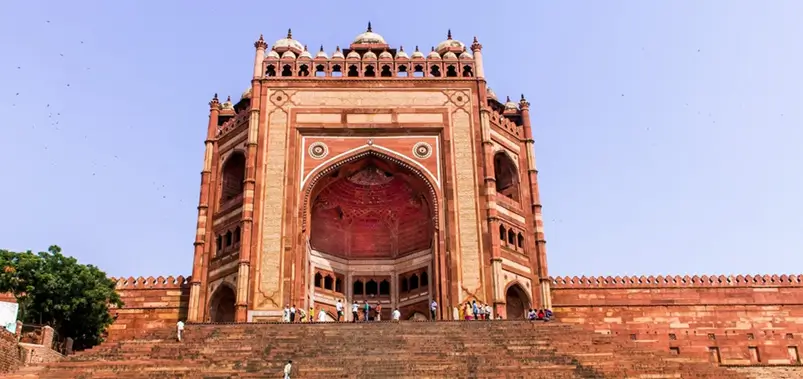
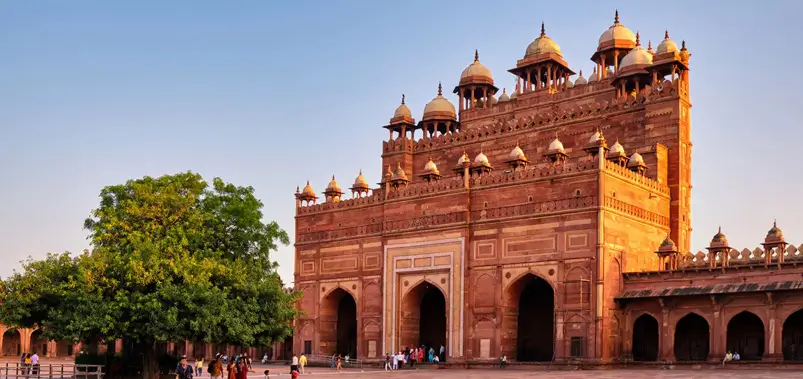
Among all structures in Fatehpur Sikri, none commands attention quite like Buland Darwaza.
Constructed to commemorate Akbar's victory in Gujarat, the gateway rises approximately fifty four meters above the surrounding landscape and remains one of the largest ceremonial entrances ever built.
Approaching the structure is an experience in itself. Visitors ascend a long flight of steps before reaching the massive entrance, creating a sense of anticipation and scale.
The gateway's size becomes even more impressive when viewed alongside people standing nearby. Photographs rarely capture the true dimensions effectively.
Architectural details reward close observation. Carvings, inscriptions, and decorative elements demonstrate the sophistication of Mughal craftsmanship.
Morning visits are often particularly enjoyable because temperatures are cooler and lighting conditions enhance the sandstone's color.
Many photographers spend considerable time at Buland Darwaza because the structure offers opportunities ranging from dramatic wide-angle compositions to intricate detail studies.
The gateway serves as both an architectural achievement and a political statement. It was designed to inspire awe, and centuries later it continues to achieve that objective.
For many travelers, Buland Darwaza becomes the defining image of Fatehpur Sikri.
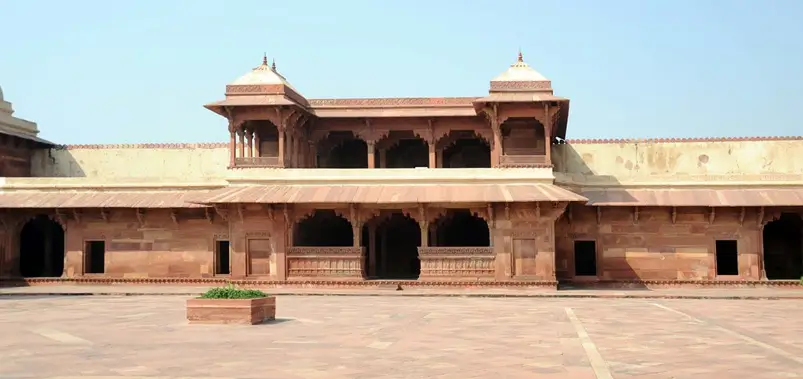
One of the most fascinating sections of Fatehpur Sikri is the residential area associated with the imperial family.
Jodha Bai Palace is among the most visited buildings in the complex and provides insight into daily life within the Mughal court.
The architecture differs from some of the more formal administrative structures. Decorative elements, courtyards, living spaces, and private areas create a more personal atmosphere.
Visitors often notice the blending of artistic influences. Architectural details reflect a combination of traditions that developed during Akbar's reign, illustrating how different cultural ideas interacted within the empire.
The palace also helps humanize historical figures. Rather than focusing exclusively on battles and politics, it encourages visitors to consider how people lived, worked, and interacted within the royal environment.
Nearby structures further expand this perspective. Residential buildings, audience halls, and courtyards reveal the complexity of life within the imperial capital.
Travelers interested in history frequently find these areas more engaging than expected because they provide context rather than simply displaying architectural achievements.
Walking through these spaces creates a stronger understanding of how the city functioned when it served as the center of one of the world's most powerful empires.
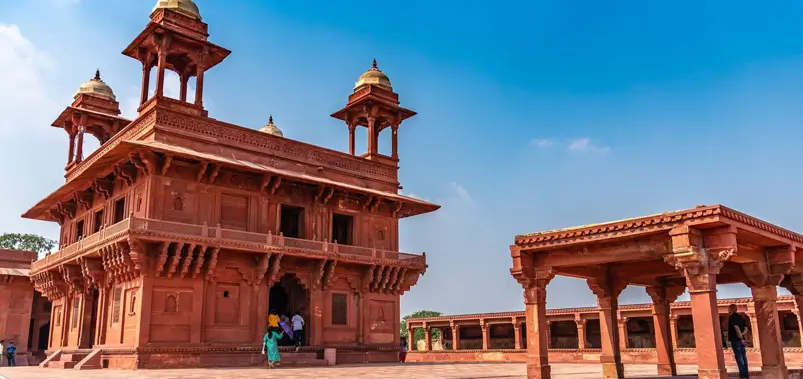
Among all the structures inside Fatehpur Sikri, Diwan-i-Khas is often the building that captures the imagination of history lovers.
The name translates roughly as the "Hall of Private Audience," and it was here that Emperor Akbar met important officials, advisors, diplomats, and distinguished visitors.
At first glance, the building appears relatively modest compared with some of the grand palaces and gateways elsewhere in the complex. However, the interior contains one of the most unusual architectural features in India.
At the center stands a massive carved pillar supporting a circular platform connected by stone bridges to surrounding galleries. Historians believe Akbar may have used this central platform during discussions and debates with scholars from different religious and philosophical traditions.
The intricate carvings covering the pillar are extraordinary. Visitors often spend significant time examining the details because they demonstrate the remarkable craftsmanship of Mughal artisans.
One of the reasons Diwan-i-Khas remains so popular is the sense of mystery surrounding its exact function. While historians have developed theories, the structure continues to inspire discussion and interpretation.
Photography enthusiasts appreciate the building because the interior geometry creates unique compositions. The combination of symmetry, texture, and light makes it one of the most visually interesting spaces within Fatehpur Sikri.
For many travelers, Diwan-i-Khas represents Akbar's intellectual curiosity as much as his political power.
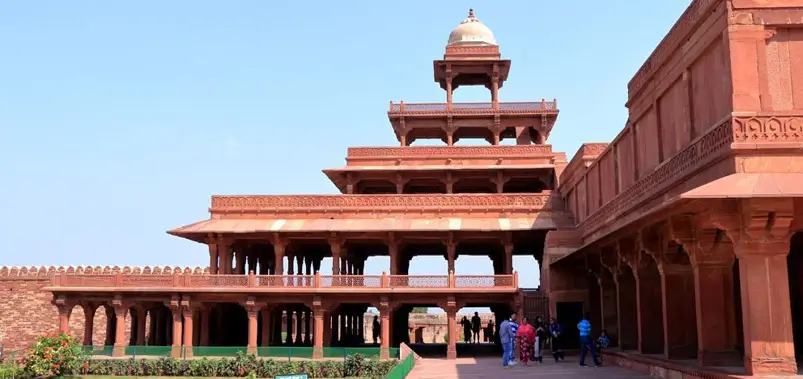
A short distance from Diwan-i-Khas stands one of the most recognizable buildings in the complex: Panch Mahal.
Unlike many Mughal structures characterized by enclosed spaces and monumental walls, Panch Mahal feels open, airy, and surprisingly delicate.
The five story pavilion was designed using rows of columns that become progressively smaller as the structure rises. This creates a tiered appearance unlike any other building in Fatehpur Sikri.
Historians believe the structure may have served as a place where members of the royal household could enjoy cooler temperatures and panoramic views. The design allowed breezes to circulate freely, making it particularly comfortable during hot weather.
Visitors today enjoy many of the same advantages. The open architecture creates excellent opportunities to appreciate the scale of the surrounding city.
Photographers frequently rank Panch Mahal among the most attractive locations in Fatehpur Sikri. The repeating columns create striking patterns, and changing light conditions throughout the day produce dramatically different visual effects.
The structure also illustrates how Mughal architects combined aesthetics with practicality. Every element served both a functional and artistic purpose.
For travelers interested in architecture, Panch Mahal provides a fascinating contrast to the more formal and monumental buildings elsewhere in the complex.
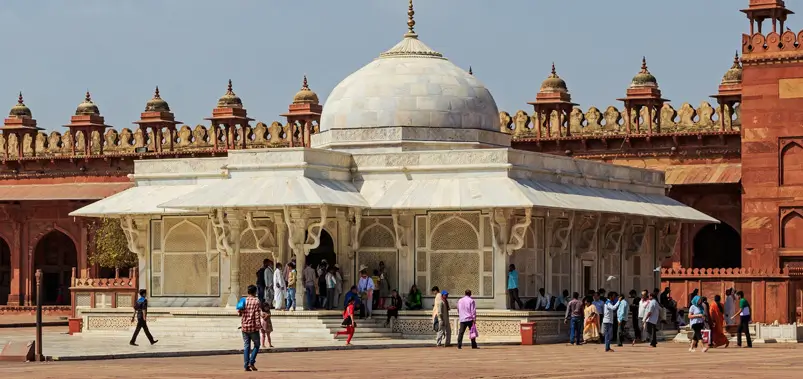
While Fatehpur Sikri is often associated with imperial power, its spiritual heart is undoubtedly the Tomb of Salim Chishti.
Located within the courtyard of the Jama Masjid, this elegant white marble mausoleum honors the Sufi saint Salim Chishti, whose blessing is believed to have played an important role in Akbar's life.
The contrast between the white marble tomb and the surrounding red sandstone architecture is immediately striking. Visitors often describe it as one of the most beautiful structures within the entire complex.
Unlike many historical monuments that function primarily as tourist attractions, the tomb remains an active place of devotion. Pilgrims continue to visit regularly, offering prayers and seeking blessings.
One of the most recognizable traditions involves tying threads to the marble screens surrounding the tomb while making wishes. Visitors frequently observe this practice throughout the day.
The atmosphere inside the complex tends to be quieter and more reflective than other parts of Fatehpur Sikri. Even travelers with no religious connection often appreciate the sense of peace found here.
Architecturally, the tomb is remarkable. Delicate marble lattice screens, intricate carvings, and balanced proportions demonstrate exceptional craftsmanship.
Many visitors consider the Tomb of Salim Chishti one of the highlights of their visit because it adds emotional and spiritual depth to the broader historical experience.
One of the most intriguing questions surrounding Fatehpur Sikri concerns its relatively short life as an imperial capital.
How could such a magnificent city be abandoned after so much effort and investment?
Historians continue debating the exact reasons, but water availability is generally considered one of the most important factors. Maintaining a large capital city in the region presented significant challenges, particularly as population and administrative demands increased.
Strategic considerations may also have influenced the decision. The Mughal Empire was expanding, and political priorities evolved over time. Different locations offered advantages that Fatehpur Sikri could not provide.
It is important to understand that the city was not abandoned suddenly in the dramatic sense often portrayed in popular stories. Rather, its role gradually diminished as imperial attention shifted elsewhere.
The result, however, is extraordinary for modern visitors.
Because the city was not continuously redeveloped over centuries, many original structures survived remarkably well. Travelers today can explore a historical environment that retains much of its original character.
The story of Fatehpur Sikri therefore adds another layer of fascination. Visitors are not simply exploring a successful capital but also a place that represents ambition, experimentation, and historical change.
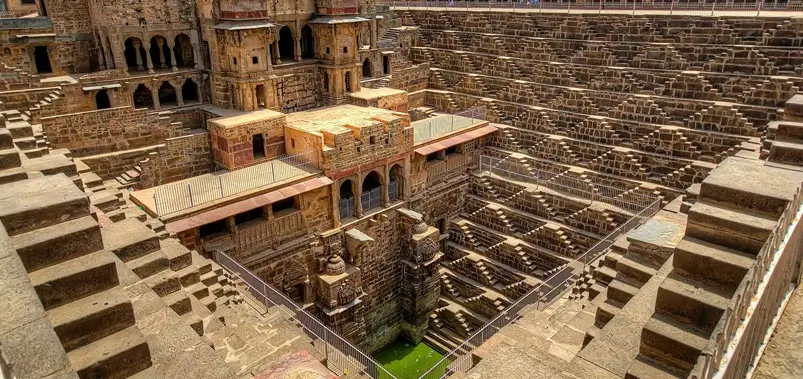
After leaving Fatehpur Sikri and continuing toward Jaipur, travelers eventually reach one of India's most remarkable hidden treasures: Chand Baori in the village of Abhaneri.
Many visitors arrive with modest expectations and leave completely amazed.
At first glance, Chand Baori appears almost impossible. Thousands of perfectly aligned steps descend dramatically into the earth, creating a geometric masterpiece that looks more like a modern art installation than an ancient water reservoir.
Built more than a thousand years ago, the stepwell was designed to collect and conserve water in a region where every drop mattered.
The scale is extraordinary.
From the viewing platform, visitors can appreciate the stunning patterns created by the staircases. Every angle offers a different perspective, making the site a paradise for photographers.
Opening Hours
8:00 AM – 6:00 PM
Entry Fee
Currently:
Free Entry
(subject to future policy changes)
Recommended Visit Duration
45 minutes to 1 hour
Most travelers spend longer than expected because the site is so visually compelling.
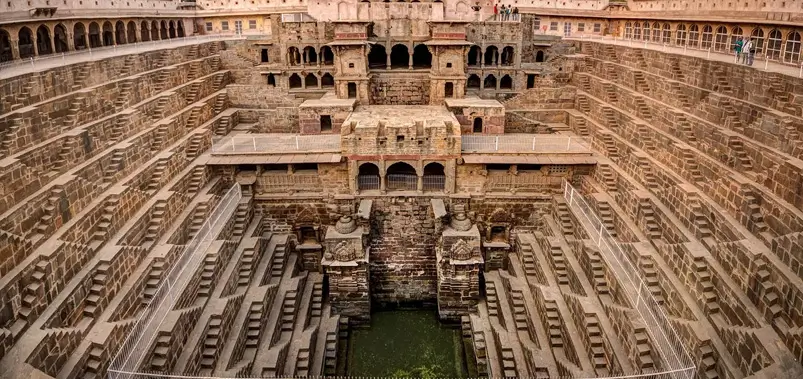
Photographers often consider Chand Baori one of the most photogenic sites in Rajasthan.
The best images usually come from elevated viewing positions that reveal the full geometry of the structure.
Morning visits offer softer light and fewer visitors. Late afternoon provides warmer colors and dramatic shadows that emphasize the depth of the stepwell.
Popular photographic subjects include:
Travelers interested in architecture frequently find themselves taking far more photographs here than they originally anticipated.
The site rewards patience. Small changes in angle dramatically affect composition.
8:00 AM
Depart Agra after breakfast.
9:00 AM – 12:00 PM
Explore Fatehpur Sikri including:
12:30 PM – 1:30 PM
Lunch stop.
3:00 PM – 4:00 PM
Visit Chand Baori and Harshat Mata Temple.
4:00 PM – 4:30 PM
Tea break and photography.
6:00 PM
Arrive in Jaipur.
This schedule allows comfortable sightseeing without rushing.
Approximate Costs
Fatehpur Sikri Entry
Foreign tourists:
Approximately ₹610–₹650 per person
Chand Baori
Free
Private Car and Driver
Typically:
₹5,000–₹12,000 per day
depending on vehicle category.
Lunch
Usually:
₹500–₹2,000 per person
depending on restaurant choice.
Guide at Fatehpur Sikri
Generally:
₹1,000–₹2,500
depending on language and duration.

We promise you a holiday where everything is taken care of from the moment you land. Trusted drivers waiting for you, handpicked hotels that fit your style, personalized itineraries designed just for your family, and a dedicated team on call 24/7. All you need to do is relax, explore, and create unforgettable memories, while we take care of every detail behind the scenes.
Because they provide two completely different yet equally impressive experiences. Fatehpur Sikri showcases imperial Mughal grandeur, while Chand Baori demonstrates extraordinary engineering and architectural creativity. Together they turn an ordinary travel day into one of the highlights of the Golden Triangle journey.
Yes. The journey is comfortable, and both attractions appeal to visitors of different ages.
Basic facilities are available nearby, but most travelers prefer eating between Fatehpur Sikri and Abhaneri or after arriving in Jaipur.
October through March generally offers the most comfortable weather conditions.
Usually not. Compared with major attractions such as the Taj Mahal, it remains relatively peaceful.
Not mandatory, but a knowledgeable guide significantly improves understanding of the city's history and architecture.
Yes. Many visitors say it looks even more dramatic in person because photographs rarely capture its depth and scale accurately.
Absolutely. This is one of the most popular and rewarding sightseeing combinations on the Agra–Jaipur route.
Most travelers need at least two to three hours to appreciate the major attractions properly.
Yes. The two sites are very different. Agra Fort is a fortress-palace, while Fatehpur Sikri is an entire abandoned imperial city.