
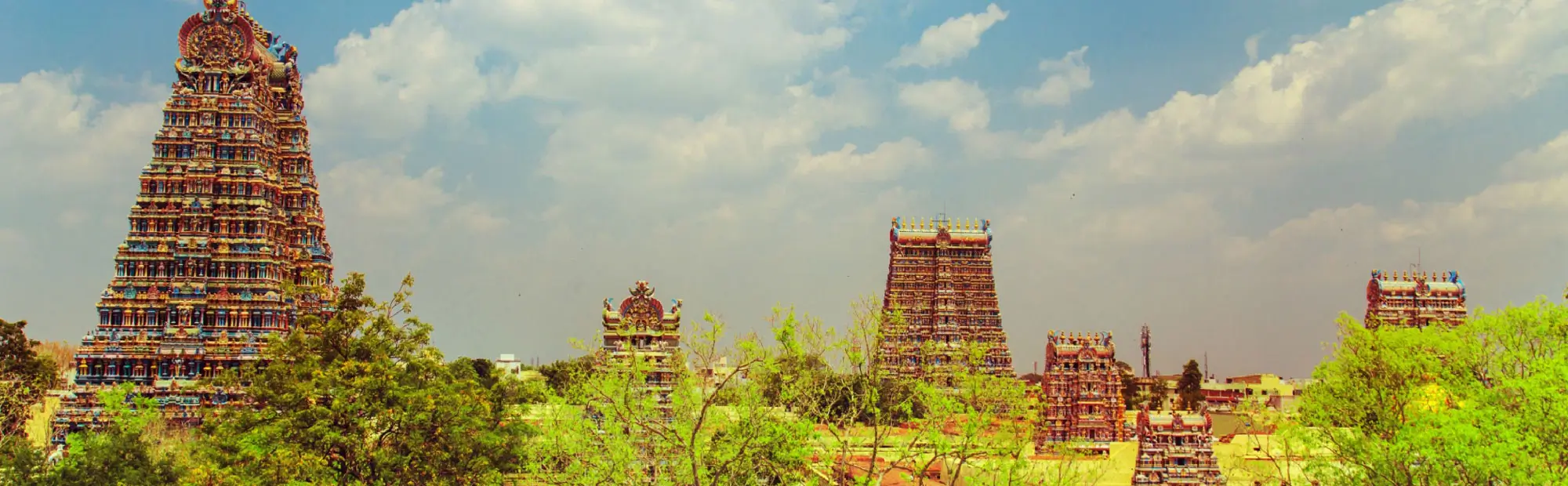
Madurai is one of the oldest continuously inhabited cities in South India and a major center of Tamil culture and Hindu devotion. Located in the state of Tamil Nadu, Madurai is most famous for the magnificent Meenakshi Amman Temple, a sprawling temple complex that dominates the city skyline with its colorful gopurams (ornate entrance towers).
Unlike Kerala’s tranquil backwaters or Munnar’s tea-covered hills, Madurai is intense, vibrant, and deeply rooted in religious life. The city revolves around temple rituals, flower markets, and daily ceremonies that have continued for centuries.
For international travellers, Madurai offers one of the most striking examples of Dravidian temple architecture, distinct from North Indian temple styles. The scale, color, and sculptural detail of the Meenakshi Temple create an overwhelming visual experience.
Madurai is often included in Tamil Nadu itineraries along with Rameswaram, Thanjavur, and Chettinad. It provides an authentic immersion into South Indian spirituality and heritage.

Meenakshi Amman Temple, Thirumalai Nayakkar Palace, Gandhi Memorial Museum, Temple Night Ceremony, Madurai Flower Market

October – March
Pleasant temperatures for sightseeing.

1–2 Days
Two days allow temple exploration and palace visit.

English, Tamil
English widely spoken in hotels and by guides.
The Meenakshi Amman Temple is the spiritual and architectural heart of Madurai. Dedicated to Goddess Meenakshi (a form of Parvati) and Lord Sundareswarar (Shiva), the temple complex spans over 14 acres and features 14 towering gopurams covered in thousands of colorful sculptures.
Each gopuram is intricately decorated with mythological figures, deities, animals, and symbolic motifs. The scale of detail is extraordinary and represents centuries of artistic devotion.
Inside the temple, visitors encounter pillared halls, shrines, sacred tanks, and ritual spaces. The Hall of Thousand Pillars showcases intricate carvings and symmetry characteristic of Dravidian craftsmanship.
Unlike quieter monasteries in Dharamshala or Bodh Gaya, Meenakshi Temple is vibrant and active. Devotees queue for darshan (sacred viewing), priests conduct rituals, and temple musicians perform traditional instruments.
Foreign visitors are welcome in most sections, though access to inner sanctums may be restricted to practicing Hindus.
One of the most unique experiences in Madurai is the nightly ceremony in which the image of Lord Shiva is symbolically carried to rest beside Goddess Meenakshi. This ritual includes chanting, music, and participation from temple staff.
The ceremony offers insight into the temple’s living traditions rather than viewing it solely as a historical monument.
For travellers interested in observing authentic religious practice, attending this ceremony provides deeper cultural understanding.
Built in the 17th century, the Thirumalai Nayakkar Palace reflects Indo-Saracenic architectural influence with large domes and expansive courtyards.
Though smaller than Rajasthan’s grand palaces, the structure offers insight into Madurai’s royal past. Evening light and sound shows narrate the history of the Nayak dynasty.
The palace provides a contrast to the religious dominance of the temple complex.
Madurai also holds modern historical significance. The Gandhi Memorial Museum houses exhibits related to India’s independence movement, including photographs and documents.
The museum offers educational context beyond temple culture, adding historical depth to a visit.
Madurai’s streets are filled with flower markets, fruit vendors, textile shops, and brassware stalls. The scent of jasmine flowers, commonly used in temple offerings, fills the air.
The city’s energy feels more traditional compared to tourist-oriented destinations. Observing daily life around the temple reveals the continuity of centuries-old customs.
Unlike coastal Kerala towns, Madurai’s pace is fast and devotional rather than relaxed and scenic.
Madurai is deeply connected to Tamil language and literature. It has long been a center of Tamil scholarship and poetry.
The temple architecture represents the Dravidian style, characterized by pyramidal towers and sculptural abundance. This differs significantly from North Indian temple architecture, offering architectural diversity within an India itinerary.
Understanding this distinction helps travellers appreciate India’s regional cultural variety.
Madurai experiences a hot tropical climate. Summers (April–June) can be intense, with temperatures rising significantly.
The most comfortable period is October to March, when daytime temperatures are more moderate.
Early morning and evening temple visits are advisable to avoid midday heat.
Madurai offers mid-range and upscale hotels suitable for international travellers. Staying near the temple allows easier access to ceremonies.
Luxury options are more limited compared to metropolitan cities but comfortable boutique hotels are available.
Due to the temple-centric layout, traffic can be heavy near the central area.
Madurai is well connected by road, rail, and air within Tamil Nadu.
The city pairs well with Rameswaram (coastal pilgrimage site) or Thanjavur (famous for Brihadeeswara Temple).
Because temple visits require modest dress, visitors should wear clothing covering shoulders and knees.
Madurai is well connected in South India.

Madurai International Airport

Road connections from Chennai, Kochi, and other cities

Direct rail connections from major Tamil Nadu cities
We promise you a holiday where everything is taken care of from the moment you land. Trusted drivers waiting for you, handpicked hotels that fit your style, personalized itineraries designed just for your family, and a dedicated team on call 24/7. All you need to do is relax, explore, and create unforgettable memories, while we take care of every detail behind the scenes.
Madurai is famous for the Meenakshi Amman Temple.
One to two days are sufficient.
Yes, though inner sanctums may have restrictions.
A South Indian temple style characterized by towering gopurams.
Yes, with normal travel precautions.
October to March.
Yes, in tourism-related areas.
Yes, as part of a South India circuit.
Modest clothing suitable for temple visits.
Restricted inside certain areas.
No, it is inland.
No, it is a South India destination.


