
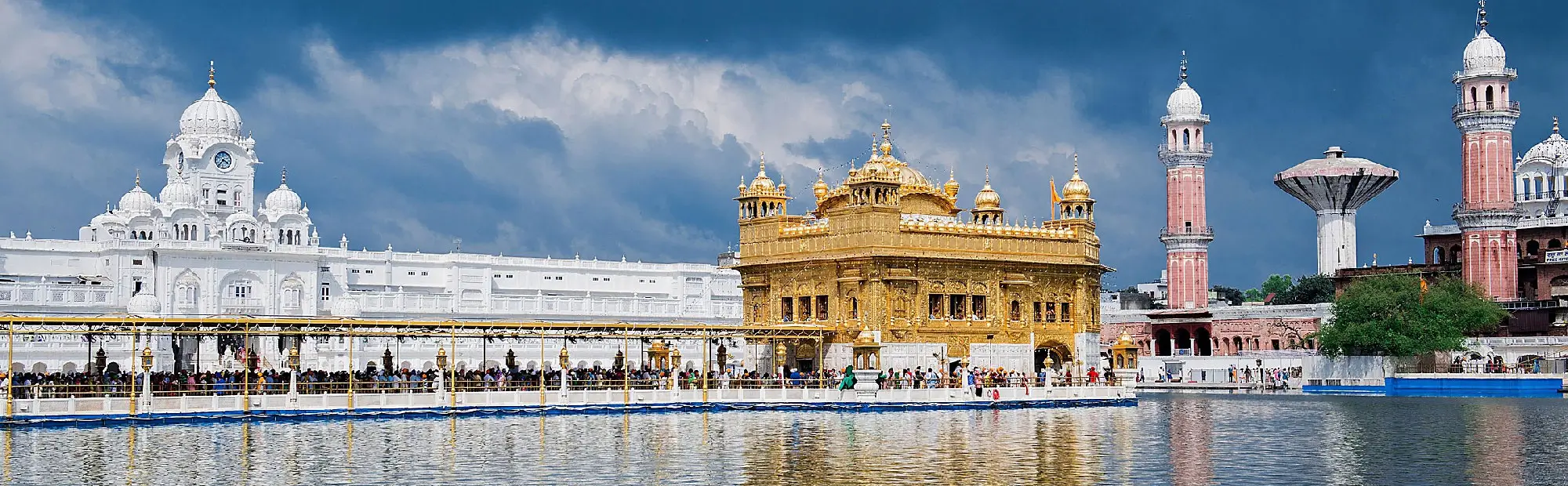
Amritsar is the spiritual and cultural heart of Sikhism and one of the most emotionally powerful destinations in North India. Located in the state of Punjab near the India–Pakistan border, the city is defined by the shimmering Golden Temple, sacred hymns echoing across the water, and a strong tradition of community service.
Unlike Varanasi’s ancient Hindu rituals or Rishikesh’s yoga-centered atmosphere, Amritsar offers a distinct spiritual identity rooted in Sikh philosophy. The city is organized, welcoming, and deeply respectful toward visitors of all backgrounds.
For international travellers, Amritsar provides not only religious significance but also historical depth and unique cultural experiences. It combines devotion, patriotism, and hospitality in a way few other Indian cities do.
Amritsar is often added after Delhi in North India itineraries and can be visited as a short but meaningful extension.

Golden Temple (Harmandir Sahib), Jallianwala Bagh, Wagah Border Ceremony, Akal Takht, Partition Museum

October – March
Pleasant weather for walking and sightseeing.

1–2 Days
One overnight stay allows temple visits and Wagah ceremony.

English, Hindi, Punjabi
English is widely spoken around major attractions.
The most iconic landmark of Amritsar is the Golden Temple, also known as Harmandir Sahib. Surrounded by the sacred Amrit Sarovar (pool of nectar), the temple’s golden façade reflects beautifully in the water, especially at sunrise and sunset.
The temple complex is open to people of all faiths. Visitors must cover their heads, remove shoes, and wash their feet before entering. The atmosphere inside is serene and inclusive.
One of the most remarkable aspects of the Golden Temple is the Langar, a free community kitchen that serves meals to thousands of people daily. Volunteers prepare and distribute food regardless of religion, nationality, or background. For many international visitors, participating in the langar becomes a memorable and humbling experience.
The continuous recitation of Sikh scripture creates a meditative environment within the complex.
Located within the Golden Temple complex, the Akal Takht represents the highest seat of temporal authority in Sikhism. It symbolizes justice and leadership within the Sikh community.
Understanding the balance between spiritual devotion and social responsibility is central to appreciating Sikh philosophy.
A short walk from the Golden Temple lies Jallianwala Bagh, a memorial site marking a tragic event in India’s independence history. In 1919, British troops opened fire on unarmed civilians gathered peacefully in the garden.
The preserved bullet marks and memorial flame create a solemn atmosphere. For international travellers, this site offers important historical context about India’s colonial past.
Located about 45 minutes from Amritsar, the Wagah Border hosts a daily flag-lowering ceremony between India and Pakistan.
The ceremony is energetic and patriotic, featuring synchronized military drills and enthusiastic crowds on both sides. It offers a unique cultural and political perspective on the region’s history.
Amritsar reflects Sikh values of equality, service, and community. The city feels organized and welcoming. Streets around the Golden Temple are pedestrian-friendly and filled with shops selling religious articles, textiles, and local sweets.
Punjab’s culinary traditions are also a highlight. Dishes such as butter chicken, dal makhani, and fresh tandoori bread are widely available in reputable restaurants catering to international visitors.
Compared to some other spiritual cities, Amritsar feels structured and accessible, making it comfortable even for first-time travellers to India.
The Partition Museum provides detailed narratives about the division of India and Pakistan in 1947. Through personal stories and archival material, visitors gain insight into one of South Asia’s most significant historical events.
This museum adds educational depth to a visit that otherwise centers on religious and patriotic themes.
Amritsar offers a range of accommodations, from boutique hotels near the Golden Temple to internationally branded properties.
Staying within walking distance of the temple allows early morning and late evening visits when the atmosphere is quieter.
The city is relatively compact, and major attractions are easily accessible.
The best time to visit is October to March when temperatures are comfortable.
Summers (April–June) can be hot, while winters (December–January) may bring foggy mornings.
Major Sikh festivals attract larger crowds but offer vibrant cultural experiences.
Amritsar is well connected in North India.

Sri Guru Ram Dass Jee International Airport

Interstate buses from Delhi and Chandigarh

Direct rail connections from Delhi

We promise you a holiday where everything is taken care of from the moment you land. Trusted drivers waiting for you, handpicked hotels that fit your style, personalized itineraries designed just for your family, and a dedicated team on call 24/7. All you need to do is relax, explore, and create unforgettable memories, while we take care of every detail behind the scenes.
Amritsar is famous for the Golden Temple, the spiritual center of Sikhism.
Yes, visitors of all religions are welcome.
One to two days are sufficient.
Yes, head covering is required inside the Golden Temple complex.
A free community meal served to all visitors.
Yes, it is considered safe and welcoming.
A daily military flag-lowering event between India and Pakistan.
Photography is allowed in outer areas but restricted inside the sanctum.
A memorial site related to India’s independence movement.
October to March offers pleasant weather.
Yes, premium hotels and curated experiences are available.
Yes, it is easily accessible from Delhi by flight or train.


